Short answer
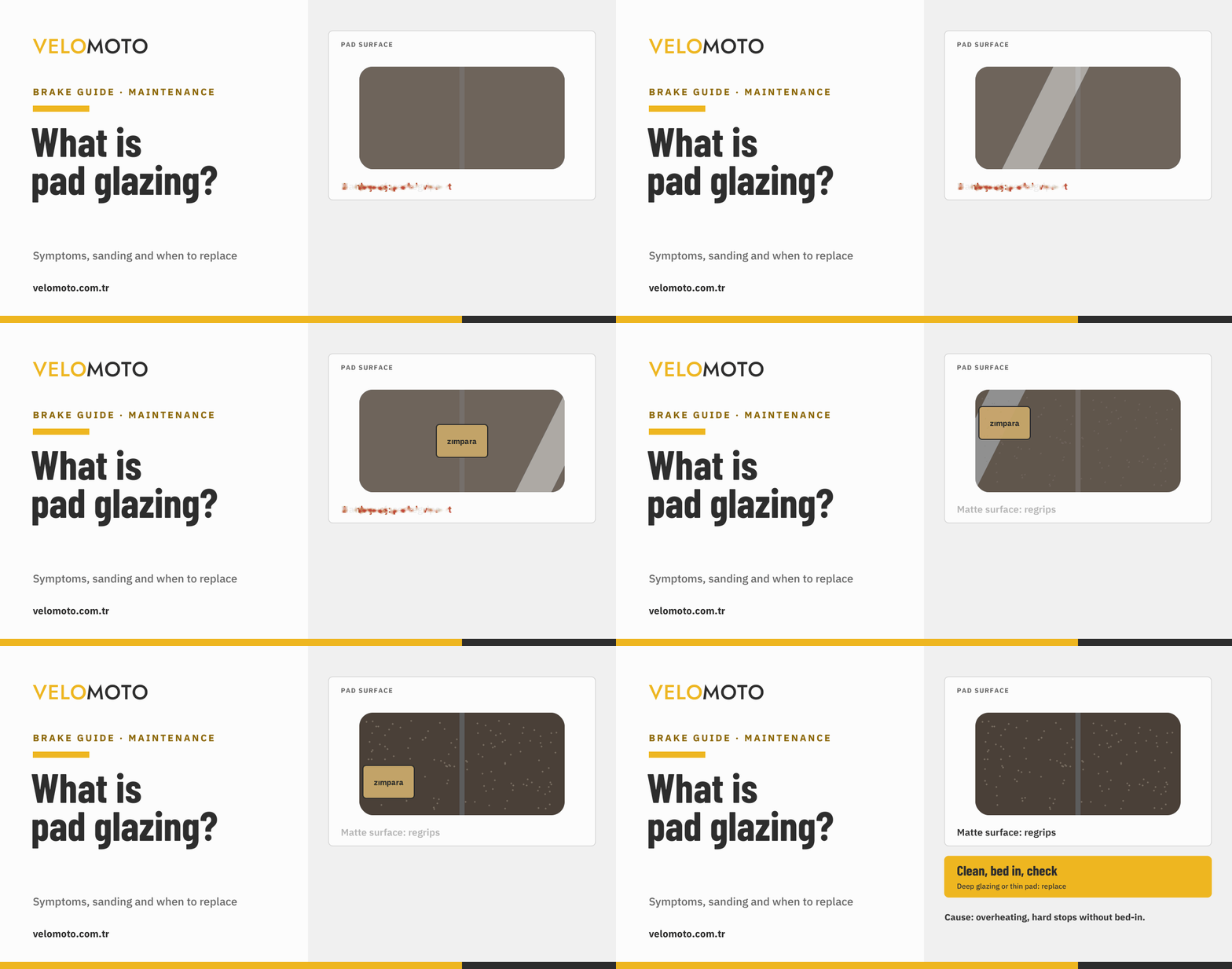
Glazing is when the surface of an overheated brake pad hardens and turns shiny and glass-like; grip drops and the brakes may make a high-pitched noise. Light glazing can often be fixed: remove the brake pad, sand it lightly on medium-grit sandpaper (about 120–150) laid on a flat surface until it is matte, clean the pad and disc, and do a new break-in. If the pad is down to 1–2 mm, is cracked, has absorbed oil, or still has no grip after sanding, replace it.
Velomoto is the official distributor of Brenta products in Turkey.
What causes glazing?
- Dragging the brakes on long downhill descents: The pad heats up without a chance to cool down.
- Hard braking without a break-in: A new pad suffers heat shock in its first kilometers.
- A series that does not suit the use: On a heavy motorcycle, organic pads may not withstand the heat of prolonged braking.
- A sticking caliper: The pad rubs on the disc constantly and heats up.
- Oil or grease contamination: Creates a similar shiny surface; in this case the pad must be replaced.
Symptoms
| Symptom | What it means |
|---|---|
| You have to squeeze the lever harder | Friction has dropped |
| High-pitched squeak or squeal | The hardened surface is vibrating |
| The pad face is shiny and smooth | Glazing; a healthy pad is matte |
| A burning smell after hard braking | Excessive heat |
| The brakes grip differently when hot and when cold | The surface layer is uneven |
Fixing it with sandpaper: step by step
- Remove the brake pads from the caliper.
- Fix sandpaper of about 120–150 grit to a flat surface such as glass or marble.
- Move the pad in a figure-eight pattern without pressing down; continue until the surface is evenly matte.
- Clean the pad with brake cleaner or isopropyl alcohol.
- Wipe the disc with brake cleaner; if the shiny layer does not come off, scuff it lightly with fine sandpaper.
- Fit the brake pads and pump the lever.
- For the first kilometers, do a new break-in with gradual braking.
Do not breathe in brake pad dust; sand with a mask on and outdoors.
When is sanding not enough?
- If the friction material is down to 1–2 mm or the wear groove has disappeared.
- If there are cracks, chips or separation from the backing plate.
- If the pad has absorbed oil, grease or brake fluid.
- If there is still no grip after sanding and break-in.
- If glazing comes back quickly: change the series and have the caliper checked.
Preventing glazing
- Always break in new brake pads.
- Use engine braking on downhill descents; do not keep the brakes applied constantly.
- For heavy motorcycles, passenger and cargo riding and mountain roads choose Brenta Sintered Road; for sporty riding choose Pro Road.
- Have the caliper pins and pistons checked at every brake pad change.
For heat-related brake fade, see our article Why don't brakes grip when they get hot?

Products in this guide
Brenta brake pads
Organic, sintered and track brake pads made in Italy, ECE R90 approved. The 2026 catalog includes an application table for more than 170 makes and 8,500+ models.
We do not sell directly to end users; you can find the products at our authorised dealers. See our dealers
Frequently asked questions
Are glazed brake pads dangerous?
Yes, because grip drops and stopping distance increases. Have the brake pads checked as soon as you notice the symptoms.
What grit sandpaper is used to fix brake pads?
Medium-grit sandpaper of about 120–150, on a flat surface. Remove only the shiny layer.
Can the disc glaze too?
A shiny layer can form on the disc too. Clean it with brake cleaner; if it does not come off, scuff it lightly with fine sandpaper.
Why do new brake pads glaze?
Usually because of hard and prolonged braking in the first kilometers without a break-in.
Do sintered brake pads glaze?
They withstand higher heat; still, any brake pad can glaze under excessive heat and without a break-in.
Is a break-in necessary after sanding?
Yes. A new break-in is needed for full grip.