Short answer
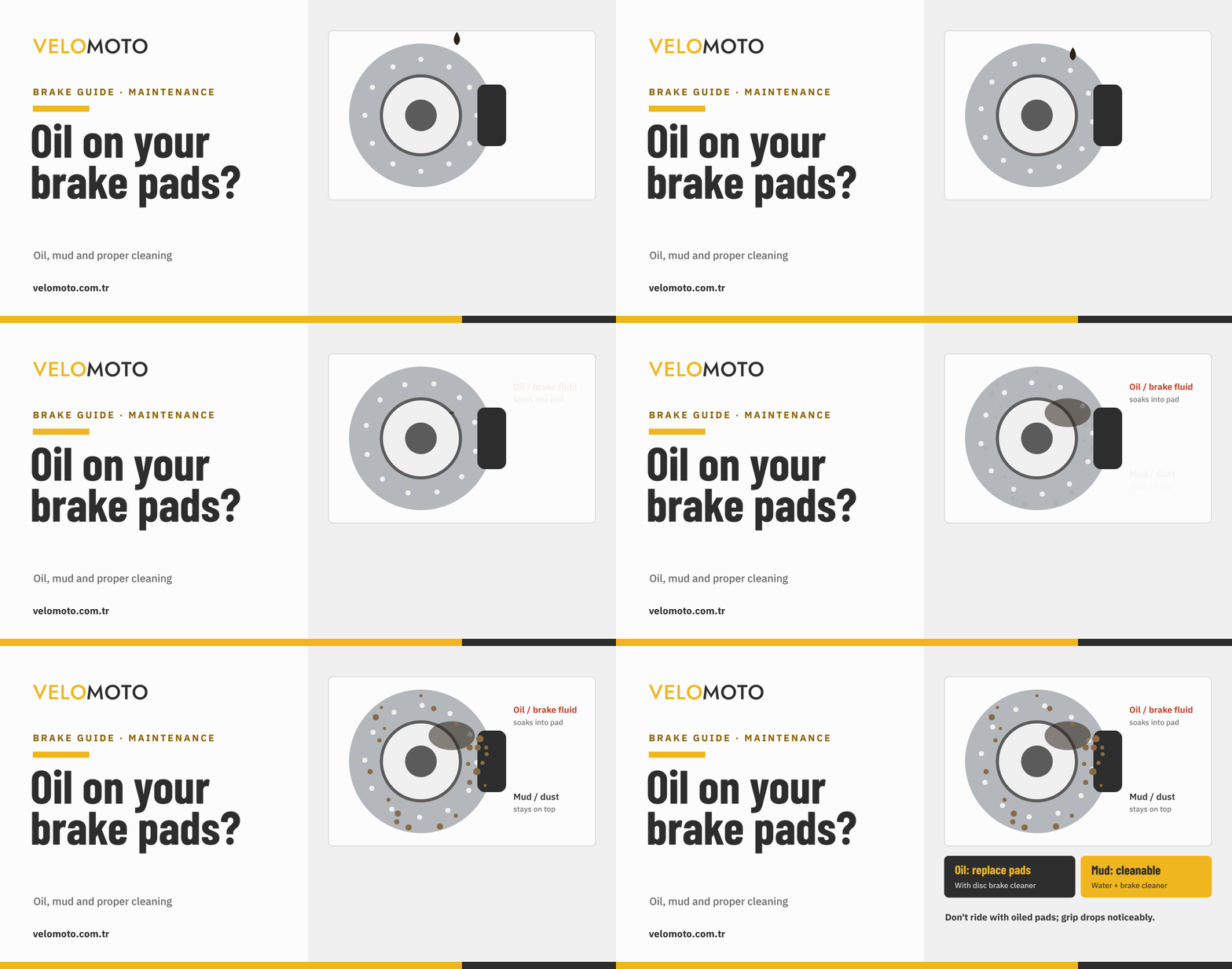
If oil, grease or brake fluid gets on a brake pad, braking weakens noticeably; because the pad is porous it soaks up the oil, and the safest solution is to replace the pad. The disc, on the other hand, can be cleaned with brake cleaner or isopropyl alcohol and reused. Mud, dust and sand usually stay on the surface; rinsing with plenty of water and cleaning with brake cleaner is usually enough. Do not ride with oil-contaminated brakes, and always find the source of the oil.
Velomoto is the official distributor of Brenta products in Turkey.
The difference between oil and mud
| Contaminant | Effect | What to do |
|---|---|---|
| Engine oil, grease, chain spray | The pad absorbs it, grip drops, noise starts | Replace the brake pads, clean the disc |
| Brake fluid | The pad absorbs it; there is a fault in the system | Fix the leak, replace the brake pads |
| Polish, silicone, tire shine | A slippery film on the disc | Clean the disc; replace the pads if it has soaked in |
| Mud, dust, sand | Stays on the surface, speeds up wear | Clean with water and brake cleaner |
How can you tell?
- The brakes are weaker than before, and you have to squeeze the lever harder.
- Squealing or squeaking has started when braking.
- There are dark, wet-looking stains on the pad face.
- There is an oily film on the disc.
- There are oil traces around the fork seal, caliper or hose connection.
How to clean the disc
- Remove the wheel or the brake pads so that cleaner does not get on the pads.
- Wipe both faces of the disc with brake cleaner or isopropyl alcohol using a lint-free cloth.
- Use a clean part of the cloth each time; do not spread the oil back.
- Repeat if necessary and let the disc dry.
- Fit new or clean brake pads and break them in with gradual braking.
We do not recommend trying to save an oil-soaked brake pad by heating or sanding it; the results of these methods are not guaranteed. On a motorcycle, replace oil-soaked brake pads.
After a muddy ride, rinse the disc and caliper with plenty of water, clean the rest with brake cleaner and check the brake pads. For how brakes behave in the rain, see our article Do Brenta brake pads perform in the rain?
First find the source of the oil
- Fork seal leak: Drips oil onto the front disc.
- Caliper seal or hose connection: Brake fluid leaks; the system must be checked immediately.
- Chain lube and sprays: Splash onto the rear disc.
- Engine or transmission leak: Can reach the rear brake.
- Care products: Polish, silicone and tire shine must not get on the disc.

Products in this guide
Brenta brake pads
Organic, sintered and track brake pads made in Italy, ECE R90 approved. The 2026 catalog includes an application table for more than 170 makes and 8,500+ models.
We do not sell directly to end users; you can find the products at our authorised dealers. See our dealers
Frequently asked questions
Oil got on my brake pads; is wiping them enough?
No. The pad soaks up the oil; wiping does not bring the grip back. Replace the brake pads.
Oil got on the disc; does the disc need replacing too?
Usually not. The disc can be cleaned with brake cleaner or isopropyl alcohol and reused.
Why do the brakes make noise after a muddy road?
Sand and mud have gotten in between. Wash and clean them; if the noise continues, have them checked.
What product should be used to clean the disc?
Brake cleaner or isopropyl alcohol. Do not use oil, polish, silicone or WD-40.
Brake fluid got on the brake pads; what should I do?
Do not ride the motorcycle. The leak must be fixed, the brake pads replaced, the disc cleaned and the system bled.
Can chain spray reach the rear disc?
It can. Cover the disc while spraying and wipe off the excess.