Short answer
Final drive ratio = rear sprocket tooth count ÷ front sprocket tooth count. As the ratio increases (a smaller front sprocket or a larger rear sprocket), the motorcycle pulls away more eagerly and more tractive force reaches the wheel; engine rpm at a given speed goes up and theoretical top speed drops. As the ratio decreases (a larger front sprocket or a smaller rear sprocket), the engine turns at lower rpm on the road and take-off is softer.
As a rough rule, 1 tooth on the front sprocket equals about 3 teeth on the rear sprocket. A sprocket change can also affect the speedometer, chain length and adjustment range.
Velomoto is the official distributor of RK Japan in Turkey.
How is the ratio calculated?
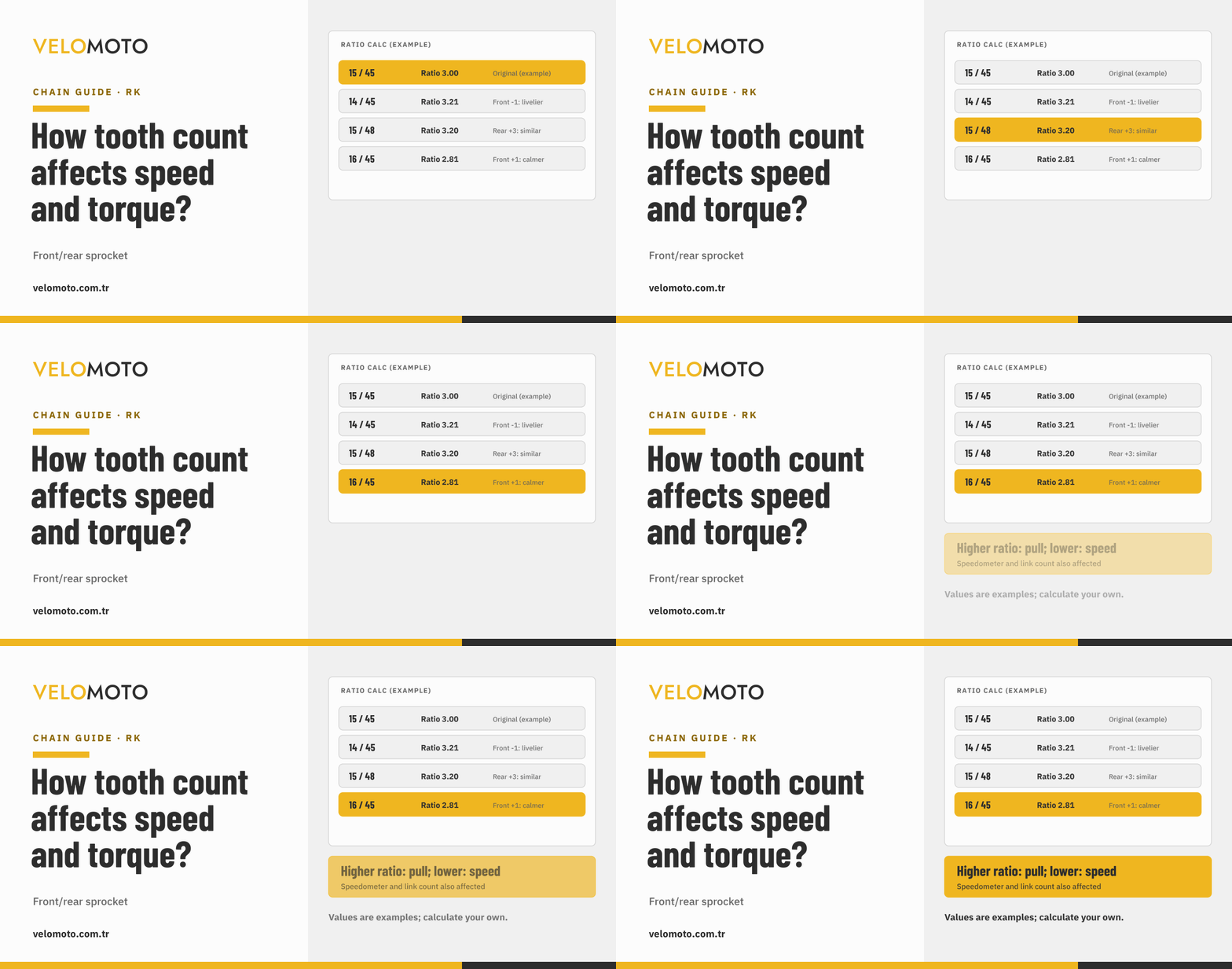
Divide the number of teeth on the rear sprocket by the number of teeth on the front sprocket. The values below are examples; take your own motorcycle's original sprocket sizes from the owner's manual.
| Front / Rear | Ratio | Difference from stock | Effect |
|---|---|---|---|
| 15 / 45 | 3.00 | — | Stock (example) |
| 14 / 45 | 3.21 | About 7% shorter | Quicker take-off, higher rpm at the same speed |
| 15 / 48 | 3.20 | About 7% shorter | Almost the same effect as front −1 |
| 16 / 45 | 2.81 | About 6% longer | Lower rpm on the road, calmer take-off |
| 15 / 42 | 2.80 | About 7% longer | Almost the same effect as front +1 |
As the table shows, a 1-tooth change on the front sprocket gives a result similar to a change of about 3 teeth on the rear sprocket.
Effect on speed, torque and rpm
| Change | Take-off and pulling power | RPM at the same speed | Theoretical top speed |
|---|---|---|---|
| Smaller front / larger rear sprocket | Increases | Rises | Drops |
| Larger front / smaller rear sprocket | Decreases | Drops | May increase* |
*With a taller ratio, top speed only increases if the engine has enough power to pull that ratio; if power is insufficient, top speed stays the same or drops.
The engine's own torque does not change; what changes is the force reaching the rear wheel. A shorter ratio is preferred for city riding, off-road and riding with a passenger; a taller ratio for fuel economy and comfort on the highway.
What to know before making a change
- Speedometer: If the speed signal is taken from the transmission or the front sprocket, the speedometer may read incorrectly. With a shorter ratio it reads above the actual speed; with a taller ratio, below it. If the speed signal comes from the rear wheel, it is not affected. On some models the odometer is affected as well.
- Chain length: Making the rear sprocket a few teeth larger or smaller changes the adjustment range. If the adjustment range is not enough, the chain's link count must change; the link count must always be even.
- Front sprocket limit: A very small front sprocket bends the chain more sharply, increasing chain and sprocket wear; a large front sprocket may contact the cover or swingarm.
- Electronic systems: On some modern motorcycles, systems such as traction control and the gear indicator may be affected by a ratio change; consult an authorized service center.
- Replace as a kit: If the chain is worn when you change sprocket sizes, renew the chain and both sprockets together.

Products in this guide
RK chains and sprockets
Chains and heat-treated sprockets made in Japan since 1953; original equipment supplier to many manufacturers including Honda, Yamaha, Suzuki and Kawasaki. 1,119 products and 3,786 model applications in the catalog.
We do not sell directly to end users; you can find the products at our authorised dealers. See our dealers
Frequently asked questions
What does a smaller front sprocket do?
It shortens the ratio: take-off and pulling power increase, rpm at the same speed rises, and theoretical top speed drops.
What does a larger rear sprocket do?
It has the same effect as a smaller front sprocket; about 3 rear teeth equal 1 front tooth.
Does a sprocket change throw off the speedometer?
If the speed signal comes from the transmission or the front sprocket, yes, there will be a deviation; if it comes from the rear wheel, no.
Does the chain change when sprocket size changes?
If the adjustment range is not enough, the link count must change. If the chain is worn, it should be replaced as a kit anyway.
Does gearing affect fuel consumption?
It can, because it changes rpm at a given speed; a taller ratio usually means lower rpm on the highway.