Short answer
A correctly chosen brake pad that is replaced on time does not damage the disc. What really damages the disc is a pad worn all the way down so its metal backing rubs on the disc, a hard compound that is not compatible with the disc, a low-quality aftermarket pad, sand or mud trapped in between, and overheating. If you hear metal-on-metal grinding from the brakes, stop riding the motorcycle and have the brake pads checked right away.
How do brake pads and discs work together?
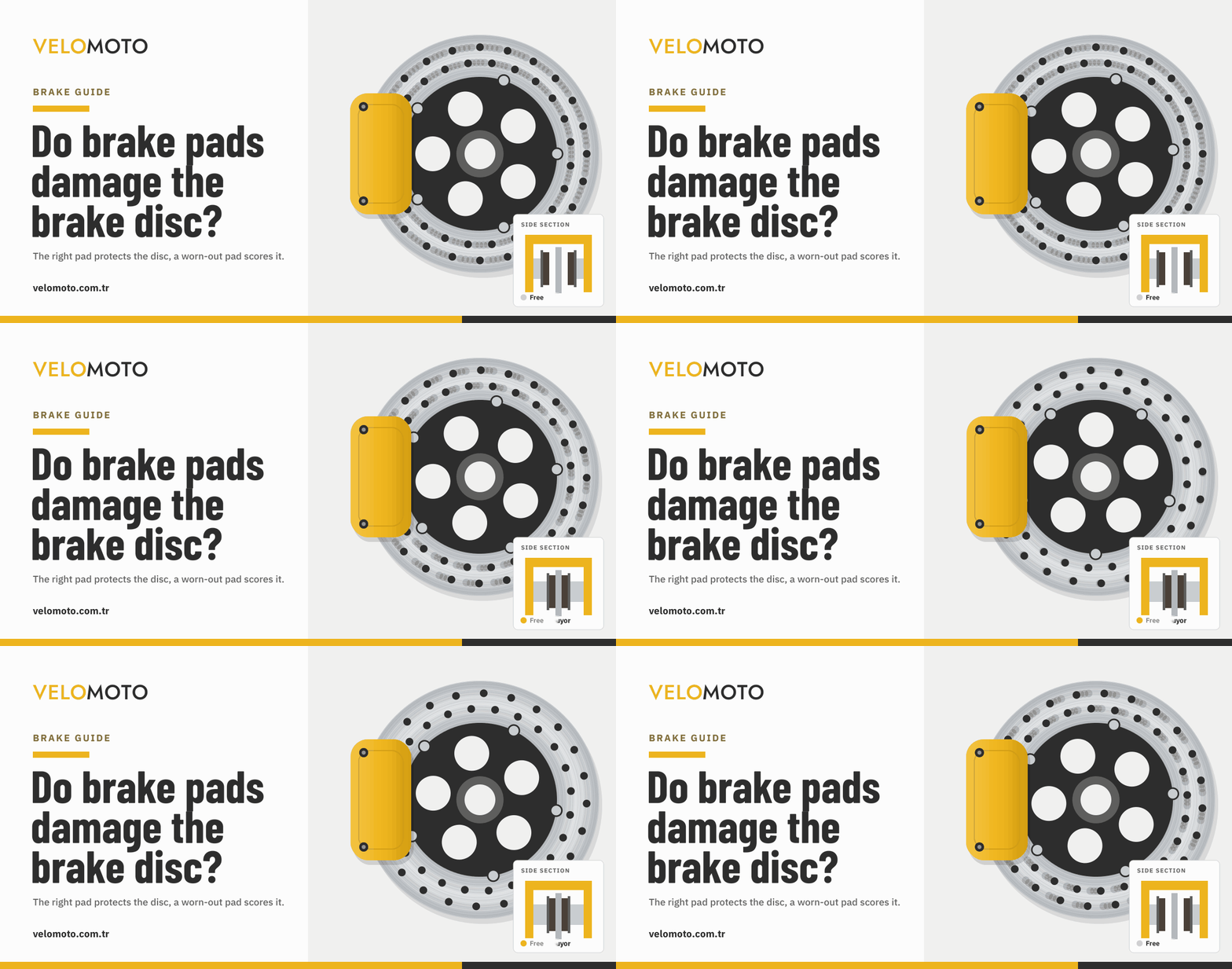
When you squeeze the brake lever, hydraulic pressure pushes the pistons in the caliper. The pistons press the brake pads against the spinning disc, and the friction turns the motorcycle's kinetic energy into heat.
Both parts wear during this friction, but at different rates. The brake pad is intentionally made from a softer material and wears out faster. The disc is made of hard steel and normally lasts through several sets of brake pads.
The brake pad leaves a thin friction layer on the disc surface. This layer is part of a healthy brake; it protects the disc surface and keeps grip consistent. Problems start when something upsets this balance.
When does a brake pad damage the disc?
- When the brake pad is worn all the way down. Once the friction material is gone, the pad's steel backing plate rubs directly on the disc and cuts deep grooves within a few kilometers. Because hydraulic brakes self-adjust, this often goes unnoticed until you hear metal noise.
- When the brake pad is not compatible with the disc. Some discs are designed for organic brake pads only. Fitting hard sintered pads to these discs speeds up wear; follow the vehicle or disc manufacturer's recommendation.
- When low-quality aftermarket pads are used. Pads with an inconsistent compound, hard metal particles in the mix or poor bonding quality score the disc.
- When dirt gets between the pad and the disc. Sand, grit and mud embed in the pad surface, act like sandpaper and leave fine circular lines on the disc.
- When the brakes overheat. Long downhill descents, constant brake dragging or a sticking caliper overheat the disc. The disc can turn bluish, warp, and the pad surface can glaze.

How can you tell the disc is damaged?
- Metal scraping or grinding noise: the pad's metal backing is touching the disc; stop riding.
- Deep grooves on the disc: if your fingernail catches on the disc surface, the score is deep.
- Blue or purplish color: the disc has overheated.
- Pulsing at the brake lever: the disc may be warped.
- Weak braking: a scored disc prevents a new pad from bedding in fully.
- A noticeable lip at the edge of the disc: the disc has worn thin; have its thickness measured.
Every disc has a MIN TH (minimum thickness) value printed on it. If the disc has worn below this value, it must be replaced no matter how new the brake pads are. For the brake pad, it is time for replacement if the wear groove has disappeared or the friction material has become very thin.
Brake pad types and their effect on the disc
| Brake pad type | Effect on the disc | Best use |
|---|---|---|
| Organic | Gentlest on the disc | Scooters, city riding, light motorcycles |
| Semi-metallic | Moderate wear | Daily use, mid-range motorcycles |
| Sintered | Normal on a compatible disc; speeds up wear on an incompatible disc | High performance, heavy motorcycles, wet surfaces, off-road |
| Ceramic | Low wear | Riders who want comfort and low dust |
We explain the difference between organic and sintered brake pads in detail in our guide Organic or sintered?
7 tips to protect your brake disc
- Check brake pad thickness at every service and before long trips.
- Replace the brake pads when the wear groove disappears, before you hear metal noise.
- Choose quality brake pads with a compound suited to your motorcycle and your disc.
- Avoid hard and prolonged braking for the first 100–200 km with new pads.
- Replace the front brake pads on both calipers together, as a set.
- Keep caliper pins and pistons clean; a sticking piston presses the pad against the disc all the time.
- Clean the disc only with brake cleaner; do not let oil, polish or silicone get on it.

Products in this guide
Brenta brake pads
Organic, sintered and track brake pads made in Italy, ECE R90 approved. The 2026 catalog includes an application table for more than 170 makes and 8,500+ models.
We do not sell directly to end users; you can find the products at our authorised dealers. See our dealers
Frequently asked questions
How far can you ride on worn-out brake pads?
Not at all. The moment the metal backing touches the disc, the disc suffers permanent damage within a few kilometers and braking power drops sharply.
Do sintered brake pads wear the disc?
On a disc suitable for sintered brake pads, wear is at a normal level. They only speed up wear on discs designed for organic brake pads.
Can a scored disc be machined?
Motorcycle discs are thin, so they are generally not machined. Light scoring is not a problem; if there are deep grooves or the thickness is below the MIN TH value, the disc is replaced.
Should the brake pads be replaced when the disc is replaced?
Yes, that is recommended. The old pads have taken on the shape of the old disc and will not seat fully on the new disc.
Do cheap brake pads ruin the disc?
Unapproved pads with an unknown compound can score the disc. Choose an ECE R90 approved brake pad that suits your motorcycle.
Does noise from new brake pads mean they are damaging the disc?
Slight noise during break-in is normal. Metal scraping noise is not normal; have the brake pads checked.
Will fitting cheap or aftermarket brake pads ruin the brake disc?
It can. The compound of an unapproved pad of unknown origin may not suit the disc and can score it. Buying aftermarket pads is fine; choose ECE R90 approved pads from a known manufacturer, with the correct part code.