Short answer
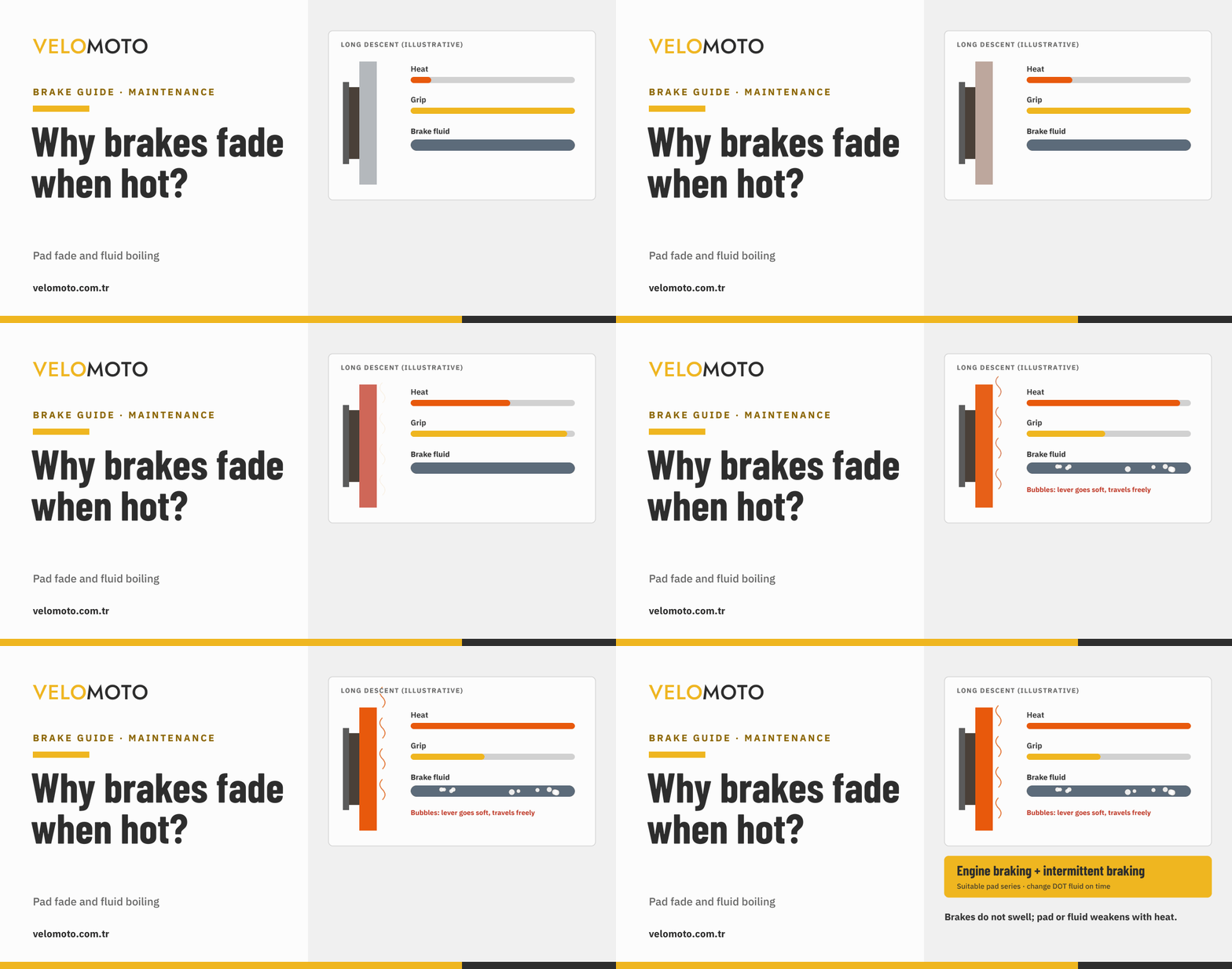
There are two main reasons brakes stop gripping when hot: brake pad overheating (fade) and boiling brake fluid. When a brake pad exceeds the temperature it can withstand, its friction drops; the lever stays firm but the motorcycle stops late. Brake fluid absorbs moisture over time and its boiling point drops; when it heats up, vapor bubbles form, and the lever goes soft and travels without effect. What people commonly call "swollen brakes" is usually one of these; a sticking caliper also causes the brakes to overheat.
Velomoto is the official distributor of Brenta products in Turkey.
Why do brakes weaken? Three situations
| Situation | What happens | Symptom |
|---|---|---|
| Brake pad fade | The binders in an overheated pad give off gas, forming a layer between the pad and the disc | Lever firm, brakes not gripping; burning smell |
| Brake fluid boiling | Vapor bubbles form in fluid that has absorbed moisture; the vapor compresses | Lever soft, travels without effect |
| New brake pad fade | A new pad gives off gas during its first high-heat cycles | Weakening during the first hard stops with new pads |
Why does brake fluid boil?
DOT 3, DOT 4 and DOT 5.1 brake fluids absorb moisture from the air; as moisture increases, the boiling point drops.
| Brake fluid | Dry boiling point | Wet boiling point |
|---|---|---|
| DOT 3 | 205 °C | 140 °C |
| DOT 4 | 230 °C | 155 °C |
| DOT 5.1 | 260 °C | 180 °C |
The wet value is for fluid that has absorbed 3.7% water by volume. Change the brake fluid at the interval the manufacturer recommends and use the DOT class printed on the master cylinder cap.
"Swollen" brakes: a sticking caliper
If a piston or pin sticks, the pad keeps rubbing on the disc even after the brake is released; the disc, pads and fluid heat up constantly. A disc that is extremely hot after a ride and a wheel that is hard to turn are signs of this. Details: Does cleaning caliper pins and pistons affect brake pad life?
What to do when the brakes weaken
- Reduce your speed with engine braking.
- Pull over somewhere safe and stop.
- Wait for the brakes to cool down; do not pour cold water on the disc and caliper.
- If the lever is still soft after cooling, do not ride until the fluid has been changed and the system bled.
- Have the brake pad surface checked; excessive heat may have glazed the pad.
How to prevent it
- Engine braking on hills: Instead of keeping the brakes on constantly, brake briefly and firmly, then release.
- A brake pad suited to the use: Brenta Sintered Road for heavy and loaded riding, Pro Road for sporty riding.
- Do a break-in.
- Change the brake fluid at the manufacturer's interval.
- Have the caliper checked at every brake pad change.
Related: Do Brenta sintered brake pads work on high-cc bikes? · Brake pad glazing

Products in this guide
Brenta brake pads
Organic, sintered and track brake pads made in Italy, ECE R90 approved. The 2026 catalog includes an application table for more than 170 makes and 8,500+ models.
We do not sell directly to end users; you can find the products at our authorised dealers. See our dealers
Frequently asked questions
Why don't the brakes grip when they get hot?
Either the brake pads have overheated or the brake fluid has boiled. If the lever is firm, the pads are the more likely cause; if the lever is soft, the fluid is.
What does "swollen brakes" mean?
It usually refers to brakes weakening as they heat up, or to brake pads dragging constantly because of a sticking caliper.
How often should brake fluid be changed?
At the interval in the service manual. It should be changed even on a little-used motorcycle, because it absorbs moisture.
Can DOT 5.1 be used instead of DOT 4?
Use the class printed on the master cylinder cap. Silicone-based DOT 5 must never be mixed with the others.
Do sintered brake pads fade?
They withstand higher heat; still, any brake pad can weaken under very long, continuous braking.
Can I pour water on hot brakes?
No. Sudden cooling can damage the disc and caliper.
Does a hot brake pad make the brake fluid "swell"?
Heat from the brake pad passes into the fluid through the caliper; fluid that has absorbed moisture can boil and form bubbles, and the lever goes soft. If the pad itself exceeds its limit, its grip also drops.
Why does the brake lever go soft and lose feel under hard braking?
The most common cause is hot brake fluid boiling. Air in the fluid, old fluid or an expanding rubber hose also reduce feel. If the lever stays firm but the brakes do not grip, the problem is more likely the brake pads overheating.