Short answer
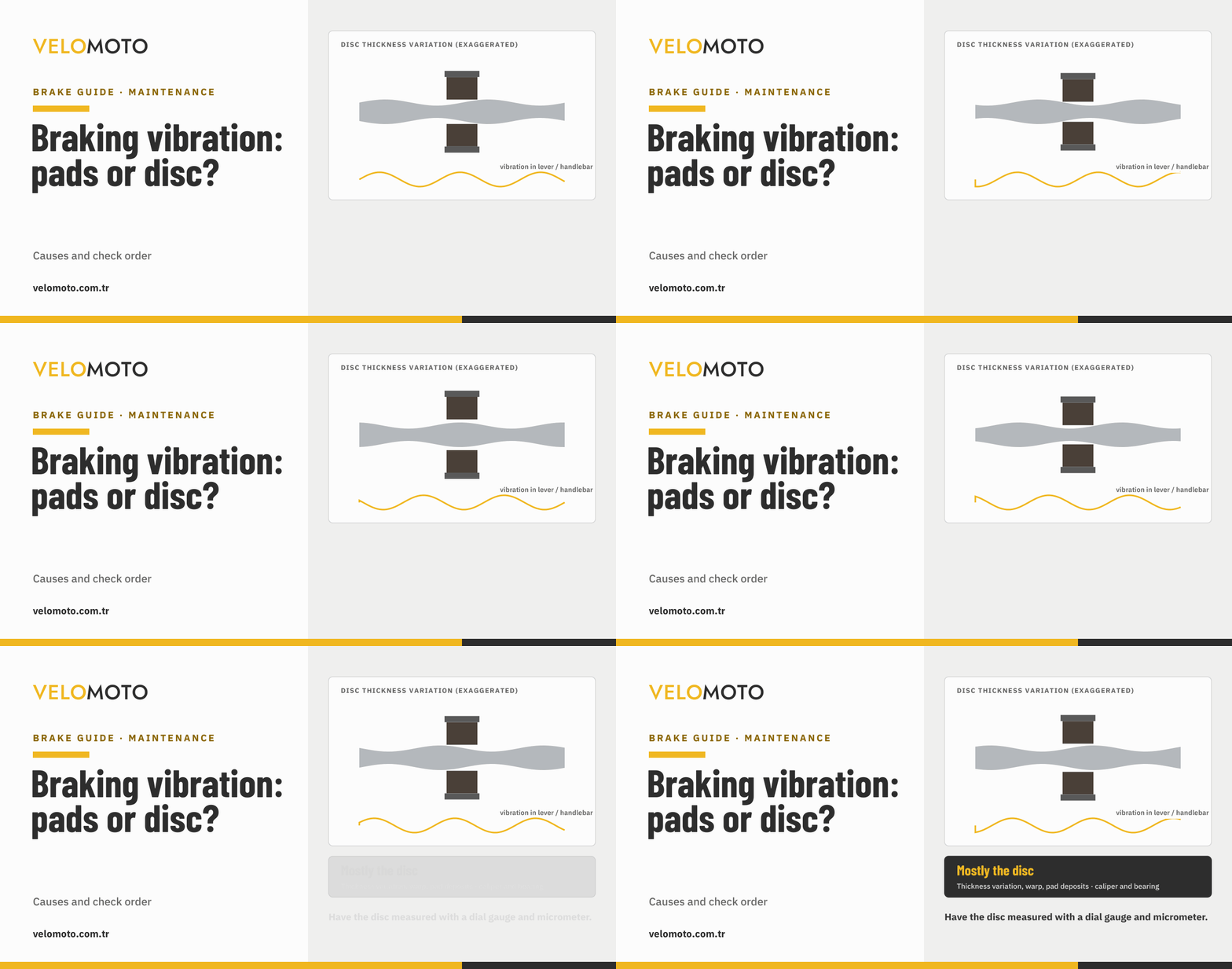
Vibration felt in the lever, handlebars or frame when braking usually comes from the disc, not from the brake pads themselves. The most common causes are uneven disc thickness around the circumference, lateral runout of the disc (commonly called warping) and pad material deposited unevenly on the disc surface. Glazed or oil-contaminated brake pads can start this deposit. Loose disc bolts, caliper mountings and bearings also cause vibration. Do not replace the disc or brake pads without measuring first.
Velomoto is the official distributor of Brenta products in Turkey.
Causes of vibration
| Cause | How it happens | How to tell |
|---|---|---|
| Disc thickness variation | The disc does not wear to the same thickness everywhere; pressure pulses as the thicker area passes through the caliper | Measure at several points with a micrometer |
| Lateral runout (warping) | The disc wobbles sideways as it turns; from an impact, excessive heat or incorrect installation | Measure with a dial indicator |
| Pad deposits | Holding the brake on hard with a hot disc leaves a pad imprint | Dark patches on the disc |
| Loose disc bolts, floating disc rivets | Play in the mounting | Torque and hand check |
| Caliper and fork mountings | Loose bolts or a sticking caliper | Torque, pin and piston check |
| Bearings and front end | Play in a wheel or steering head bearing | Lift the motorcycle and check for play |
| Tire | Deformation, balance | Vibration even when riding without braking |
Is "the disc is warped" always true?
The most common cause of vibration is disc thickness variation and uneven pad deposits on the surface. "Warping" is not a diagnosis; it is a claim that needs to be measured. Replacing parts without measuring may hide the vibration for a while but will not fix the cause.
Brake pads or disc? Order of checks
- Define the symptom: In the lever or the handlebars? At the front brake or the rear?
- Visual check: Patches, blue discoloration, deep grooves or cracks on the disc.
- Mountings: Disc and caliper bolts, floating disc rivets.
- Disc measurement: Thickness with a micrometer, runout with a dial indicator.
- Brake pads: Glazing, oil or an uneven surface.
- Caliper: Do the pins and pistons move freely?
- Bearings and front end.
Solutions and prevention
- Light deposits: Clean the disc, check the brake pads and break them in again.
- Thickness variation or runout out of spec: Replace the disc and brake pads together (disc and brake pad guide).
- Glazed or oil-contaminated brake pads: Replace the brake pads (glazing guide).
- Loose mountings or bearings: Fix these first.
- Prevention: Do a break-in; after a long, hard stop, do not sit holding the brake fully squeezed; tighten the disc bolts to the correct torque.

Products in this guide
Brenta brake pads
Organic, sintered and track brake pads made in Italy, ECE R90 approved. The 2026 catalog includes an application table for more than 170 makes and 8,500+ models.
We do not sell directly to end users; you can find the products at our authorised dealers. See our dealers
Frequently asked questions
Do brake pads cause vibration?
Rarely on their own. But glazed, oil-contaminated or overheated brake pads can leave uneven deposits on the disc and start vibration.
Why do the handlebars shake when braking?
The most common cause is thickness variation or runout in the front disc; play in the steering head bearing gives the same symptom.
How can I tell if the disc is warped?
You cannot tell without measuring runout with a dial indicator and thickness with a micrometer.
Is machining the disc a solution?
Motorcycle discs are thin, so they are generally not machined; discs out of spec are replaced.
I fitted new brake pads and vibration started. Why?
The break-in may not be complete, or the old disc does not match the new brake pads.
Is it dangerous to ride with vibrating brakes?
The brakes grip unevenly and stopping distance can increase; have them checked as soon as possible.