Short answer
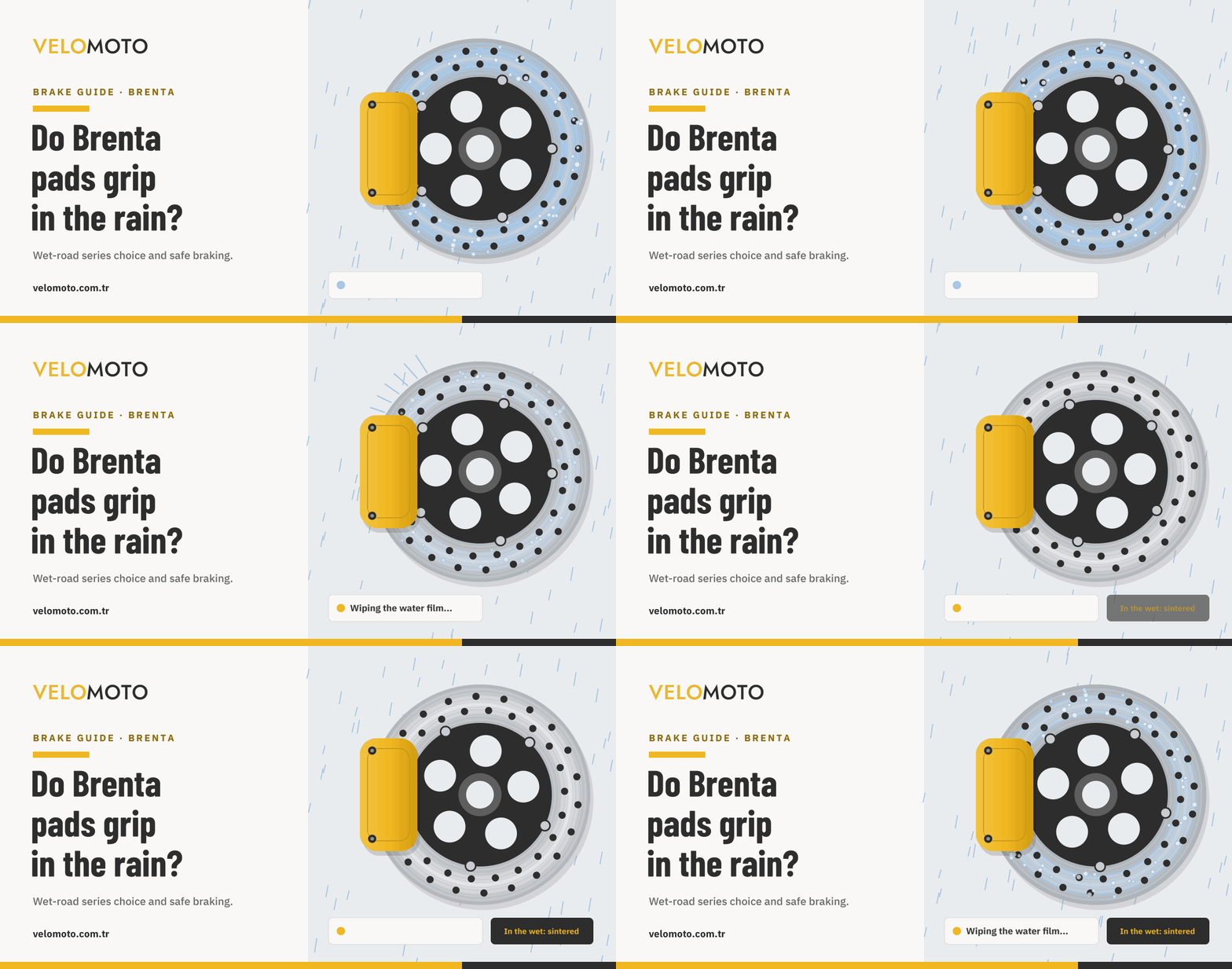
Yes, Brenta brake pads perform in wet and rainy weather; the sintered series give the best results. In the rain a thin film of water forms on the disc, and grip can be delayed for a moment on the first stop. Sintered brake pads grip more consistently than organic pads on wet surfaces. The organic city series can also be used safely in the rain, but for frequent rain, high speeds or heavy motorcycles, Sintered Road or Pro Road should be preferred.
Velomoto is the official distributor of Brenta products in Turkey.
What does rain do to the brakes?
In the rain, the brake disc surface gets wet and a thin film of water forms between the brake pad and the disc. The pad first has to wipe this water away, which is why grip can be delayed for a moment on the first stop.
A dynamometer study of motorcycle brake pads showed that older organic pads could behave unpredictably on a wet disc; because of the water film, friction dropped, especially at high speed. Sintered metal brake pads were developed as the solution to this problem. Today's organic compounds are much better, but the general trend has not changed: sintered brake pads are more consistent on wet surfaces.
In the rain, sand and mud from the road also get between the brake pad and the disc, which speeds up wear on both the pad and the disc.
Which Brenta series for wet surfaces?
| Series | Behavior on wet surfaces | Who it is for |
|---|---|---|
| Organic (Series 3) | Safe to use; the brief delay on the first stop may be more noticeable | City scooters, occasional riding in the rain |
| Sintered Road | Consistent grip in the wet; high friction in the heat and the cold | Maxi scooters and road motorcycles often ridden in the rain |
| Pro Road | High performance in very hot or cold conditions | Sporty road riding in all weather |
| Pro Off-Road | Developed for intense off-road use in all conditions | Off-road riding in mud, water and sand |
If you live in a city with frequent rain, or you do courier work, touring and long-distance riding in all weather, choose a sintered series. Make sure your disc is suitable for sintered brake pads. For the differences between the series, see our guide Organic or sintered?
Braking safely in the rain
However good the brake pad is, grip between the tire and the road drops in the rain. The biggest difference comes from how you ride:
- Increase your following distance. Stopping distance gets longer on a wet road.
- Warm the brakes lightly. If you have been riding for a long time without braking, give the brakes a light touch now and then to wipe the water off the disc.
- Brake early and smoothly. Apply the brakes gradually, not all at once.
- Use the front and rear brakes together. The load is spread over both wheels.
- Do not brake in corners. Scrub off speed before the corner, while the motorcycle is upright.
- Avoid road markings, covers and oil patches. Road markings, manhole covers and oily asphalt in the first rain are very slippery.
- If you have ABS, trust it. On a motorcycle with ABS, squeeze the brakes in an emergency; the system prevents lock-up.
Maintenance after rain
- Clean the disc and caliper. Rinse off mud and sand with plenty of water and clean the rest with brake cleaner; do not use products containing oil, polish or silicone.
- Check the brake pads. Brake pads wear faster in rainy periods.
- Look for scoring on the disc. If there are deep grooves, have the disc measured; for details see Do brake pads damage the brake disc?
- Watch out for rust. A thin layer of rust can form on a disc that stays wet for a long time; it cleans itself off in the first few stops.
- Do not neglect the brake fluid. Brake fluid absorbs moisture over time; change it at the interval the manufacturer recommends.

Products in this guide
Brenta brake pads
Organic, sintered and track brake pads made in Italy, ECE R90 approved. The 2026 catalog includes an application table for more than 170 makes and 8,500+ models.
We do not sell directly to end users; you can find the products at our authorised dealers. See our dealers
Frequently asked questions
Why do brake pads grip late in the rain?
A thin film of water forms on the disc. Because the brake pad first has to wipe this water away, grip can be delayed for a moment on the first stop.
Which brake pad is better for rainy weather?
Sintered brake pads grip more consistently on wet surfaces. In the Brenta range, Sintered Road and Pro Road suit the road, and the Pro Off-Road series suits off-road use.
Are Brenta organic brake pads dangerous in the rain?
No. They are ECE R90 approved and can be used safely in the rain. For frequent rain, high speeds or heavy motorcycles, a sintered series gives better results.
Why do the brakes make noise after rain?
A thin layer of rust on the disc or trapped sand can cause noise. Thin rust clears in a few stops; if the noise continues, have the brake pads and disc checked.
Does rain shorten brake pad life?
Yes. Sand and mud from the road speed up wear. Check the brake pads more often in rainy periods.
Do drilled or wave discs make a difference in the rain?
The holes and wavy edge help throw water and dust off the disc surface. But the real difference comes from the brake pad compound and riding style.