Short answer
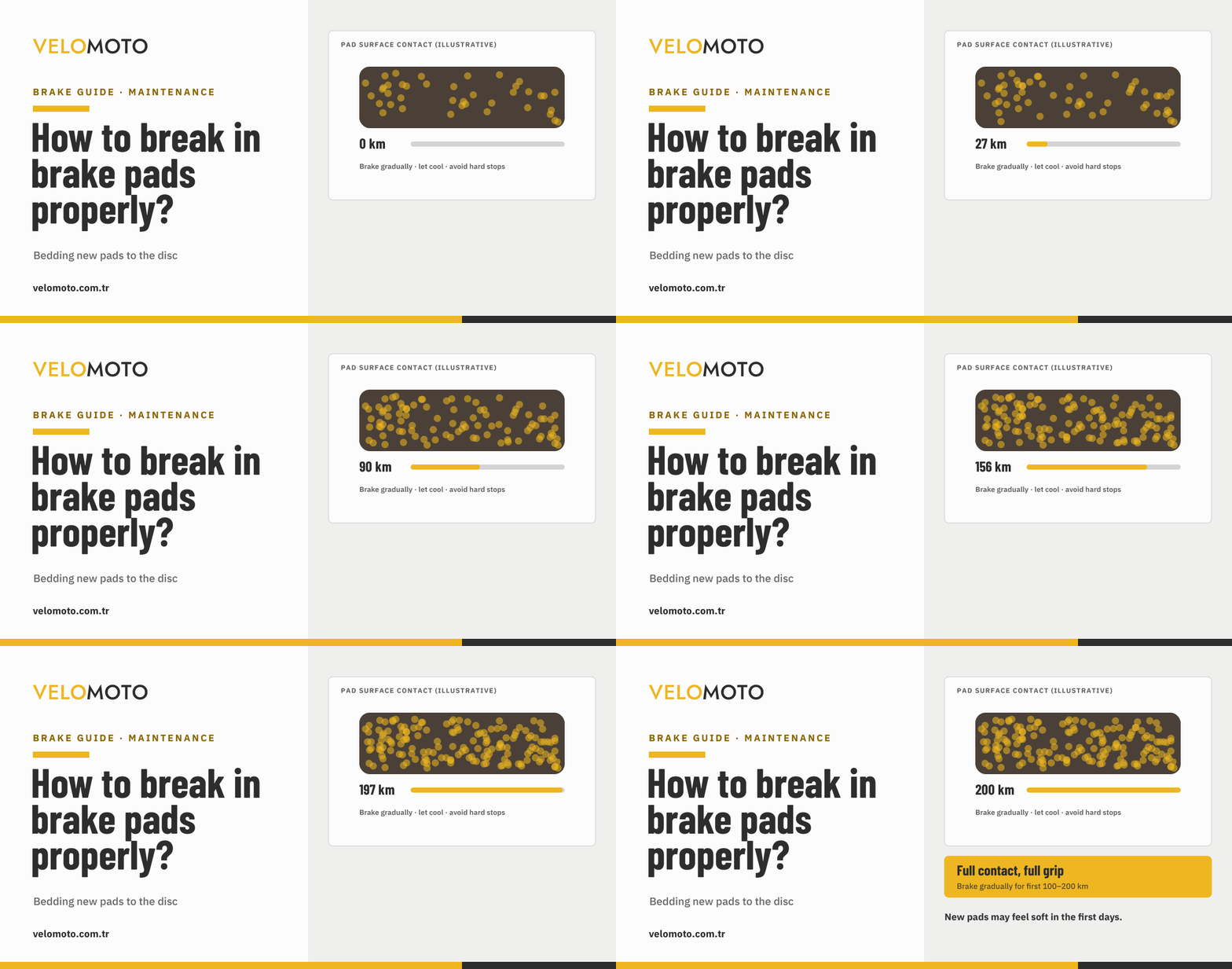
Break-in seats the surface of new brake pads against the disc and lets them lay down a thin, even layer of pad material on it; it is done by braking progressively over the first 100–200 km. Clean the disc with brake cleaner before fitting, avoid hard and long braking during the first kilometers, and let the brakes cool between repeated stops. That is why it is normal for the brakes to feel a little soft after fitting new pads; full bite comes once break-in is complete.
Velomoto is the official distributor of Brenta products in Turkey.
Why is break-in necessary?
- Surface contact: A new pad does not sit fully against the disc at first.
- Transfer layer: The pad leaves a thin, even layer on the disc; if it is uneven, it can cause vibration later.
- First heat cycles: A new pad outgasses during its first high-heat cycles and can temporarily lose some performance.
Break-in step by step
- Clean the disc.
- Pump the lever: Before riding off, until the lever or pedal is firm.
- Test in a safe area: A few gentle stops at low speed.
- Brake progressively for the first 100–200 km.
- Let the brakes cool in between.
- Avoid: Hard braking from high speed, dragging the brake downhill, and stopping with hot brakes while holding the brake on hard.
- Increase your following distance.
Why do the brakes feel soft after fitting new pads?
| Cause | What to do |
|---|---|
| Surface not seated yet | Complete the break-in |
| Pistons were pushed back | Pump the lever before riding off |
| Old, grooved disc | Have the disc measured |
| Air in the hydraulics | Bleed the brakes |
| Oil or cleaner residue on the disc | Clean the disc; replace the pads if they have absorbed oil |
When is it not normal?
- If braking is still noticeably weak after break-in.
- If the lever goes all the way to the handlebar.
- If there is metallic noise, constant squealing or vibration.
- If the wheel does not spin freely.
For stopping distance, see our guide Does Brenta increase stopping distance?

Products in this guide
Brenta brake pads
Organic, sintered and track brake pads made in Italy, ECE R90 approved. The 2026 catalog has application tables for more than 170 brands and 8,500+ models.
We do not sell directly to end users; you can find the products at our authorised dealers. See our dealers
Frequently asked questions
How many km does brake pad break-in take?
Usually the first 100–200 km.
What happens if you skip break-in?
The pads can glaze and an uneven layer can form on the disc; bite drops, and noise and vibration can start.
Do sintered pads need break-in too?
Yes. All brake pads need breaking in.
I fitted new pads, why don't the brakes grip?
The surface has not seated yet. Pump the lever and complete the break-in; if braking is still weak afterwards, have it checked.
Is break-in needed after fitting a new disc?
Yes. A new disc and pads are broken in together.
What if it rains during break-in?
That is fine; just increase your following distance even more.