Short answer
The correct chain slack varies by motorcycle; it is given in the service manual or, on most models, on a label on the swingarm. On road motorcycles this value is usually a few centimeters; common sources give a range of 20–40 mm. On off-road and adventure motorcycles, slack is greater because of the long suspension travel.
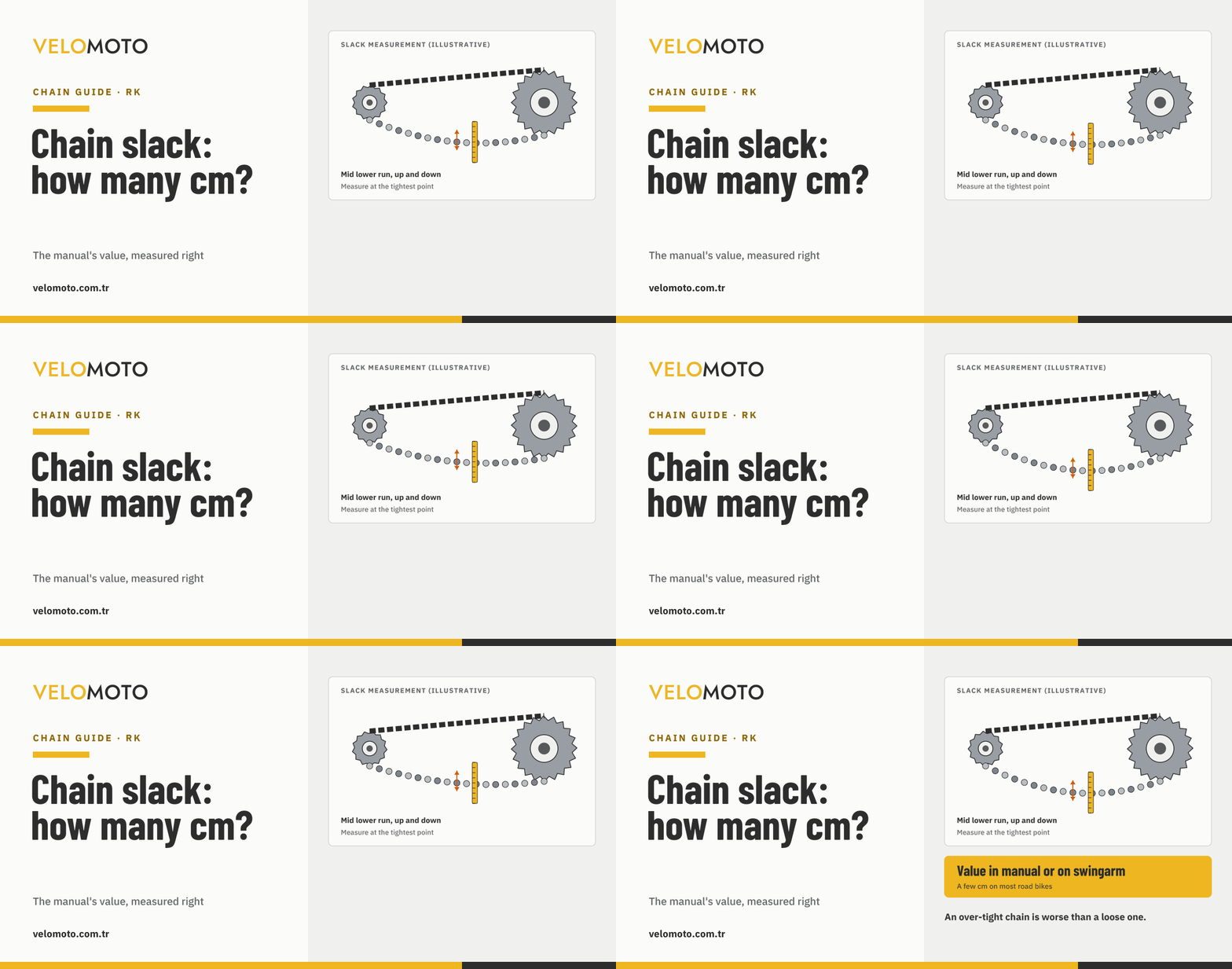
Slack is measured by pushing the chain up and down at the middle of its lower run; the wheel is turned and the reading is taken at the tightest point. A chain that is too tight is more harmful than a loose one: when the suspension compresses, the chain is stretched taut, putting strain on the front sprocket shaft, bearings, chain and sprockets.
Velomoto is the official distributor of RK Japan in Turkey.
How is slack measured?
- Stop the engine and shift into neutral.
- Position the motorcycle as the manual says (side stand, center stand or rear stand). In most manuals, the measurement is taken without a rider on board.
- Hold a ruler at the lower run of the chain, midway between the two sprockets.
- Push the chain up, then press it down; the difference between the two positions is the slack.
- Turn the wheel and measure at several different points on the chain. A chain does not wear the same everywhere; the value at the tightest point is what counts.
Typical values
| Motorcycle type | Common slack range |
|---|---|
| Road and city motorcycles | About 20–40 mm |
| Adventure, enduro and off-road | About 35–50 mm or more |
These values give only a general idea; the exact value is the one in your motorcycle's manual or on the swingarm label.
Why shouldn't it be too tight?
As the rear suspension compresses, the distance between the front sprocket, swingarm pivot and rear axle changes. The chain is at its tightest when these three points line up. A tight chain that looks “right” at rest gets over-tensioned when the suspension compresses while riding. As a result:
- The front sprocket shaft and gearbox bearings are strained.
- The chain and sprockets wear quickly.
- The suspension cannot work freely.
- In the worst case, the chain can break.
A chain that is too loose, on the other hand, slaps, hits the swingarm and slider, and can jump off the sprocket. The correct value lies between the two.
Should the rider be on the motorcycle during measurement?
Measure the way the manual describes; most manufacturers describe the measurement without a rider and on a stand. The value in the manual already accounts for suspension compression while riding. If you always ride with a passenger or a heavy load, keep the slack near the upper end of the range.
Shock and suspension changes
Shock stiffness (preload) can change the position at which slack is measured. A longer or shorter shock, a lowering kit or a different tooth count changes the swingarm angle and the chain's tightest point. After such a change, have the slack checked with the swingarm brought to the position where the chain is tightest.
If the chain keeps getting loose
A new chain beds in slightly during the first kilometers; so check the slack after the first few hundred kilometers. If the chain needs frequent adjustment, it may be worn and stretched. For details, see our guides What is chain stretch? and, for adjustment steps, How do you adjust a chain?

Products in this guide
RK chains and sprockets
Chains and heat-treated sprockets made in Japan since 1953; original equipment supplier to many manufacturers including Honda, Yamaha, Suzuki and Kawasaki. 1,119 products and 3,786 model applications in the catalog.
We do not sell directly to end users; you can find the products at our authorised dealers. See our dealers
Frequently asked questions
How many cm of slack should a chain have?
The value in the manual applies; on road motorcycles it is usually between 2 and 4 cm.
Where is chain slack measured?
At the middle of the lower run, by pushing the chain up and down.
Should I sit on the motorcycle while measuring?
Usually not; measure the way the manual says.
What happens if the chain is too tight?
When the suspension compresses, the chain is over-tensioned; the bearings, chain and sprockets are damaged.
Why does the chain keep getting loose?
A new chain beds in during the first kilometers; if it keeps loosening, the chain may be worn and stretched.
Does stiffening the shock change the chain adjustment?
It can change the position at which slack is measured; recheck the slack after a shock or ride height change.