Short answer
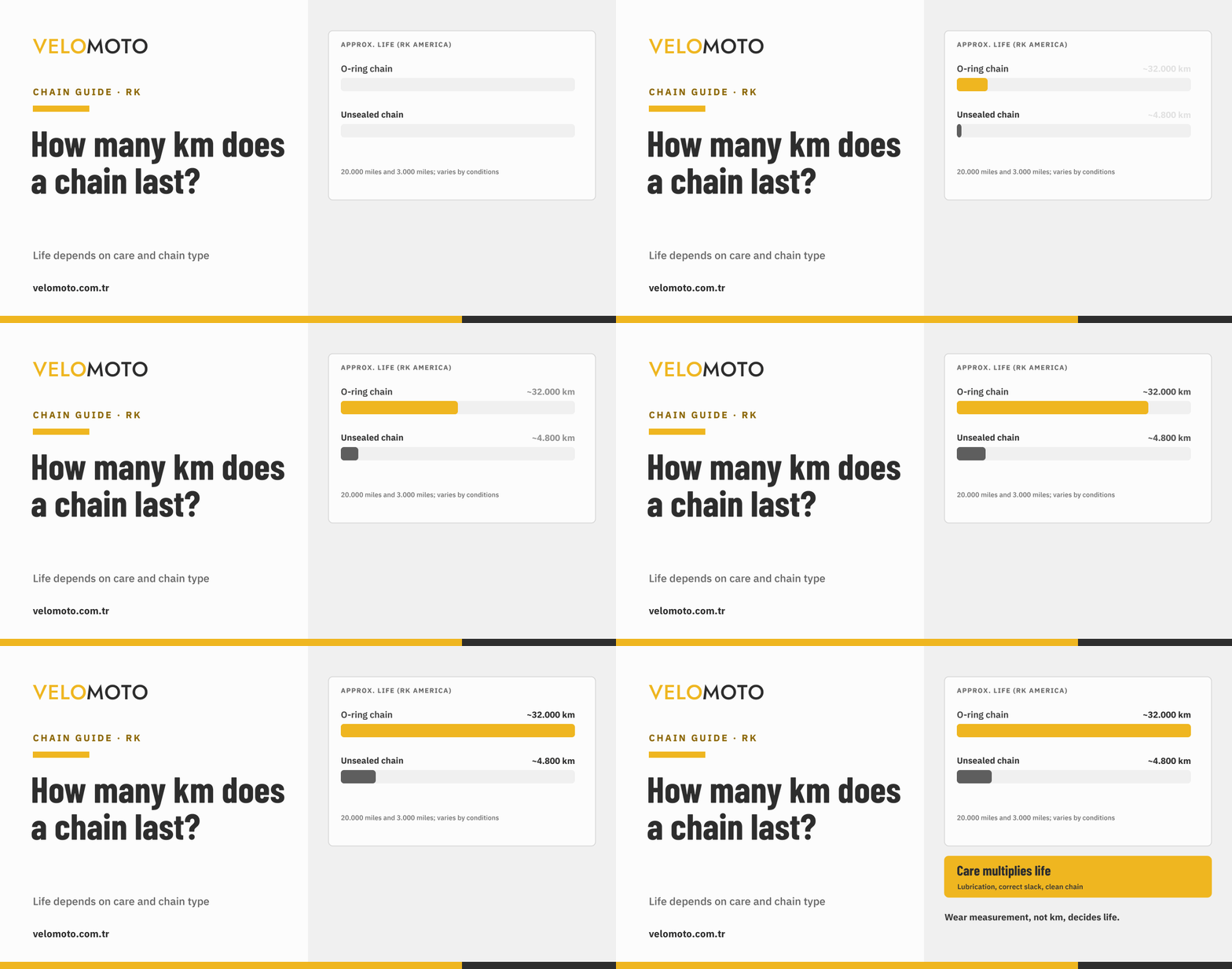
There is no single km figure for chain life; it is determined by maintenance, seal type, engine power and road conditions. RK Excel America gives a replacement interval of about 20,000 miles (~32,000 km) for sealed chains (including variants such as X-ring) and about 3,000 miles (~4,800 km) for non-sealed chains. A sealed chain that is lubricated regularly and kept at the correct tension approaches this figure; a neglected chain wears out much sooner.
The replacement decision is made by the chain's stretch and the condition of the sprockets, not the odometer. When the chain is replaced, the front and rear sprockets should be replaced too.
Velomoto is the official distributor of RK Japan in Turkey.
Approximate life by chain type
| Chain type | Approximate life (RK) | Note |
|---|---|---|
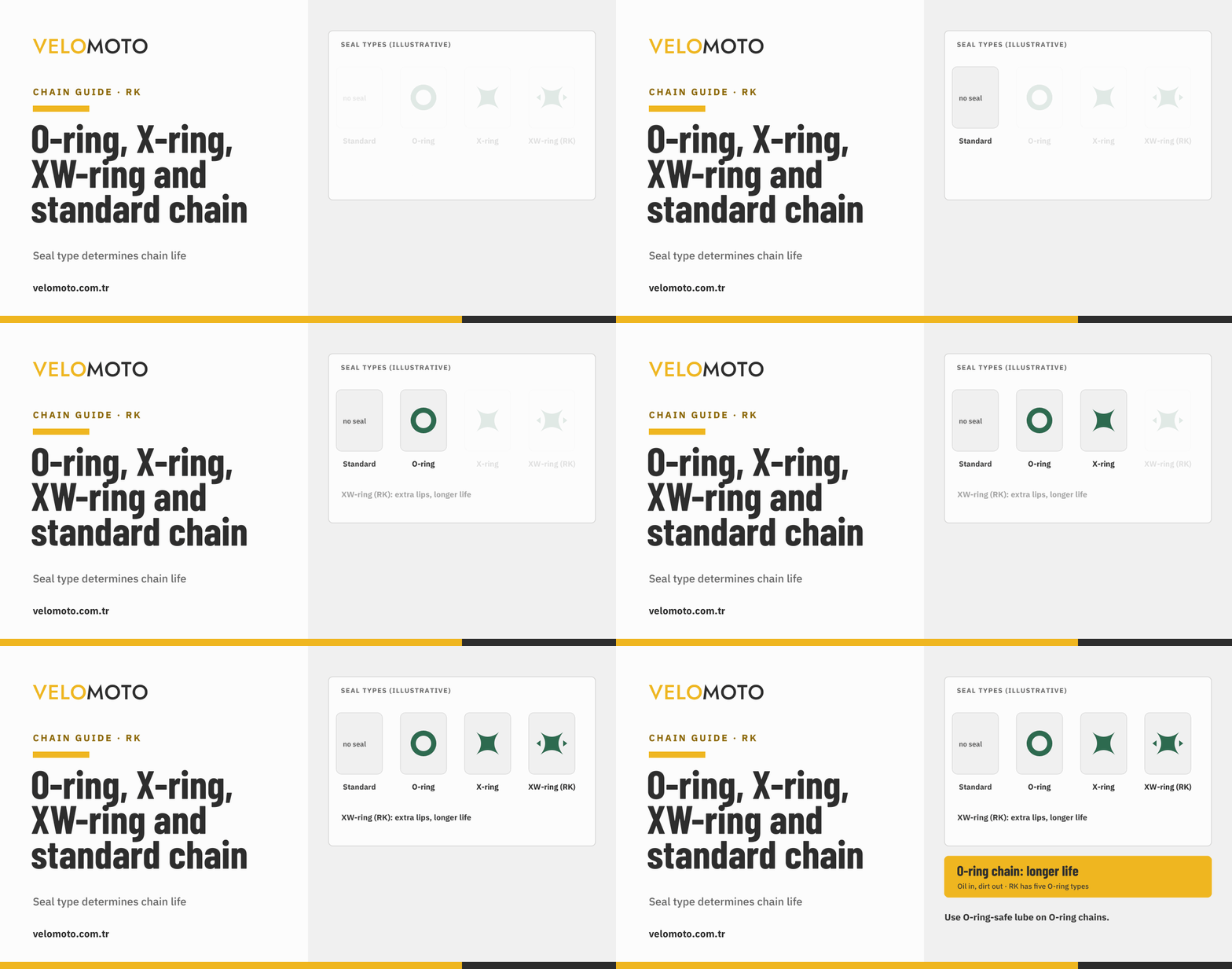
| Sealed chain (O-ring, X-ring, XW-ring) | ~20,000 miles (~32,000 km) | Thanks to the seals, the lubricant stays between the pin and bushing |
| Non-sealed (standard) chain | ~3,000 miles (~4,800 km) | Used on small-displacement motorcycles and in racing |
These values are an average starting point; the actual figure varies with use. RK's warranty for its street chains follows the same framework: 20,000 miles or 2 years (whichever comes first).
Mistakes that shorten chain life
- Not lubricating, or lubricating too rarely: A dry chain wears and rusts quickly. The general recommendation is to lubricate about every 800 km and after riding in the rain.
- Incorrect slack: A chain that is too tight strains the bearings and the chain; a chain that is too loose hits the sprocket and jumps.
- Incorrect cleaning: Kerosene, diesel, brake cleaner or a wire brush damage the seals.
- Misaligned axle: The chain runs onto the sprocket at an angle, and the plates and teeth wear on one side.
- A new chain with worn sprockets: Old sprockets stretch a new chain in a short time.
- Hard riding: Sudden launches, wheelies and high power stretch the chain faster.
- Mud, sand and salt: Off-road and winter conditions accelerate wear.
How can you tell the chain is worn out?
- If the tension keeps going out of adjustment, the chain is stretching.
- If the adjustment range has run out (the limit of the axle adjuster), the chain is finished.
- If most of the tooth shows when you pull the chain away from the back of the rear sprocket, wear is advanced.
- If some links have stiffened (do not bend) or rusted, the chain should be replaced.
- If the tips of the teeth have become hooked (shark fin teeth), the set is finished.
To measure stretch, use the measurement method and limit value in your motorcycle's manual. For details, see our guide Chain stretch.
A short list for extending life
- Lubricate the chain after a short ride, while it is warm.
- Use a seal-safe cleaner and a soft brush.
- Set the slack to the value in the manual and check the axle alignment.
- When replacing the chain, replace both sprockets too.
Products in this guide
RK chains and sprockets
Chains and heat-treated sprockets made in Japan since 1953; original equipment supplier to many manufacturers including Honda, Yamaha, Suzuki and Kawasaki. 1,119 products and 3,786 model applications in the catalog.
We do not sell directly to end users; you can find the products at our authorised dealers. See our dealers
Frequently asked questions
How many km does a motorcycle chain last on average?
According to RK, a sealed chain lasts about 32,000 km and a non-sealed chain about 4,800 km; maintenance and use change this considerably.
How many km does an RK chain last?
RK gives a replacement interval of about 20,000 miles (~32,000 km) for sealed chains; the warranty on street chains is 20,000 miles or 2 years.
Is a chain replaced by km?
No. Km gives an idea; the real decision is made by measuring stretch, the adjustment range and sprocket wear.
Why does a non-sealed chain have a shorter life?
There is no seal to hold the lubricant between the pin and bushing; the lubricant is easily thrown off and dirt gets in.
Should the sprockets be replaced when the chain is replaced?
Yes. RK recommends replacing the front and rear sprockets together with the chain.
Does a chain wear out faster on a high-power motorcycle?
Usually yes; high torque and hard riding stretch the chain faster. The right series and regular maintenance are important.