Short answer
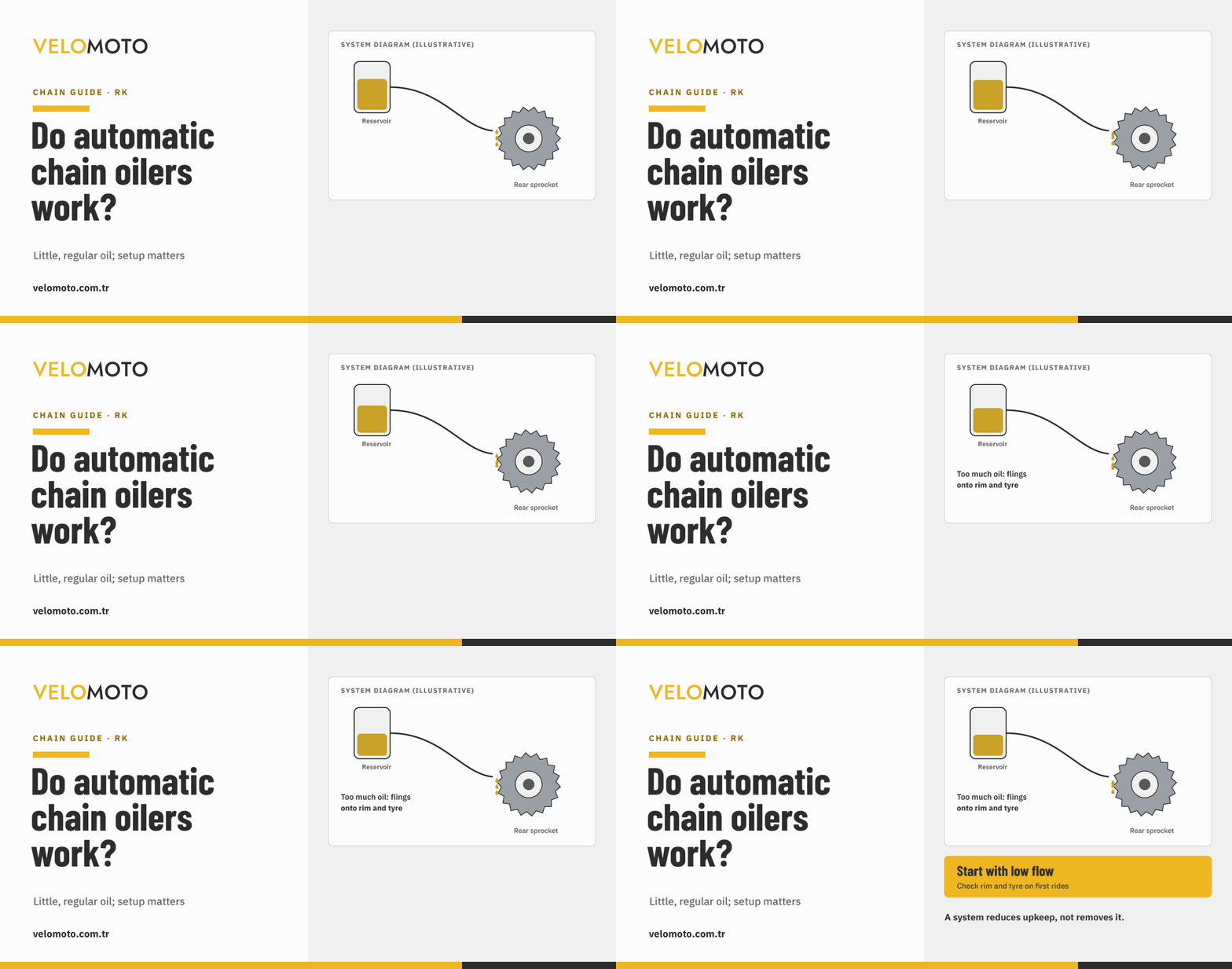
Yes, when set up correctly: an automatic oiler feeds the chain small, regular amounts of lube while riding, helping keep the chain both lubricated and cleaner. It consists of a reservoir, a thin hose and a nozzle that drips oil onto the rear sprocket. It is especially practical for touring and high daily km.
The most common problem is excess oil flinging onto the wheel, tire and rear end. Start with a low flow rate and check the wheel and tire on the first rides. An automatic system does not replace chain cleaning and tension checks.
Velomoto is the official distributor of RK Japan in Turkey.
How does it work?
- Reservoir: The oil is held in a reservoir, usually mounted under the seat or on the frame.
- Control: Some systems run an electronic pump by sensing the motorcycle's movement (e.g. with an acceleration sensor); older types use engine vacuum.
- Hose and nozzle: A thin hose carries the oil to the side of the rear sprocket; the oil passes from the sprocket to the chain.
According to one test review, even though the oil is fed from only one side of the chain, it reaches the seals on both sides and the chain stays constantly lightly lubricated.
Pros and cons
| Pros | Cons |
|---|---|
| The chain stays constantly lightly lubricated | Installation and initial setup take time |
| Holds less dirt since there is no thick layer of lube | At too high a flow rate, oil flings onto the wheel, tire and rear end |
| Reduces the need for manual lubrication on long trips | The reservoir must be refilled, and the hose and nozzle checked |
| Helps protect the chain in rainy use | Excess oil occasionally needs wiping off |
Oil flinging onto the wheel and tire
Chain lube flinging onto the wheel happens both with automatic systems and with manual lubrication. Oil on the tire tread or sidewalls reduces grip, and oil on the brake disc reduces braking power.
With an automatic system:
- Start with the lowest flow setting.
- After the first rides, check the wheel, tire sidewall and underside of the rear fender; if there is fling-off, reduce the flow rate.
- The nozzle should be in the correct position, next to the sprocket; it should not point toward the tire.
- Occasionally check for build-up inside the front sprocket cover.
With manual lubrication:
- Apply a small amount of lube to the inside of the chain.
- Let it sit for the time the product recommends, then wipe off the excess.
- Protect the wheel and tire with a piece of cardboard.
If oil got on the tire, clean it with a suitable cleaner and ride carefully; if it got on the brake disc, clean the disc with brake cleaner and check the pads. For details, see our guide What happens if oil or mud gets on the brake pads?
Who is it for?
- Long-distance riders and tourers
- Couriers who cover high daily km
- People who ride every day in a rainy climate
For someone who rides occasionally and in dry weather, regular manual lubrication is usually enough.

Products in this guide
RK chains and sprockets
Chains and heat-treated sprockets made in Japan since 1953; original equipment supplier to many manufacturers including Honda, Yamaha, Suzuki and Kawasaki. 1,119 products and 3,786 model applications in the catalog.
We do not sell directly to end users; you can find the products at our authorised dealers. See our dealers
Frequently asked questions
Is an automatic chain oiler useful?
Yes, if set up correctly; it feeds the chain small, regular amounts of lube and the chain stays cleaner.
Does the chain still need cleaning with an automatic oiler?
Yes, occasional cleaning and wiping off excess oil are needed.
Can it be used on an O-ring chain?
Yes; use the oil recommended by the system's manufacturer that is suitable for O-ring chains.
Why does chain lube fling onto the wheel?
Too much lube or incorrect application. Reduce the flow rate, or when lubricating by hand, apply less and wipe off the excess.
Oil got on the tire, what should I do?
Clean the tire and ride carefully until grip returns to normal. If it got on the brake disc, clean the disc.
Does it also adjust the chain tension?
No. Tension must be checked and adjusted separately.