Short answer
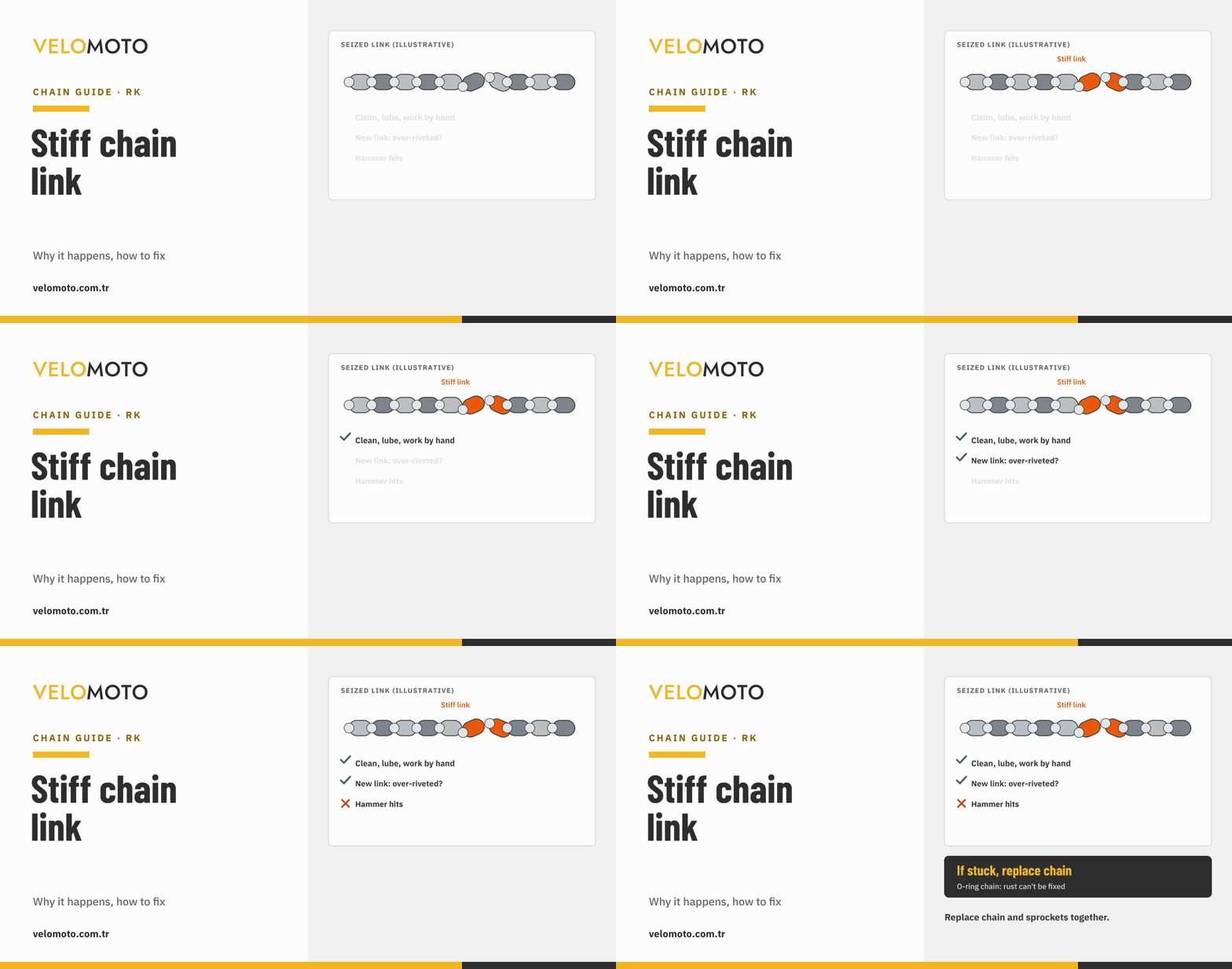
A stiff (seized) link is a link that does not straighten out after leaving the sprocket and stays kinked; it is usually caused by lack of lube, dirt, rust or over-riveting a newly fitted master link. Mild stiffness caused by lack of lube or dirt can be freed by cleaning and lubricating the chain and working the link by hand a few times.
On an O-ring chain, if the stiffness comes from loss of the internal grease between the pin and bushing or from internal rust, external lubrication will not fix it. A link that does not free up despite lubrication shows that it is time to replace the chain and sprockets.
Velomoto is the official distributor of RK Japan in Turkey.
How do you find a stiff link?
- Stop the engine, shift into neutral and lift the rear wheel on a stand.
- Turn the wheel slowly by hand and watch the lower run of the chain where it leaves the rear sprocket.
- Mark any links that do not straighten out, stay kinked, or catch for a moment and then straighten.
- Measure the chain slack at different points; a stiff link makes the chain tight in one place and loose in another.
While riding, a stiff link is felt as clatter, slight vibration, jumping or a sudden change in chain tension.
Causes
| Cause | Sign | What to do |
|---|---|---|
| Lack of lube and dirt | Chain dry, several links slightly stiff | Clean, lubricate, work by hand |
| Surface or internal rust | Orange rust, dust from between the links | Surface rust is cleaned off; with internal rust the chain is replaced |
| Over-riveted master link | Only the master link is stiff on a newly fitted chain | Have the master link checked; if necessary, rivet a new master link correctly |
| Damaged seal | Some seals missing or torn | Replace the chain and sprockets |
| Impact or bending | Link leaning sideways, plate bent | Replace the chain and sprockets |
According to RK's fitting instructions, on a rivet master link the pin head should be flared enough to hold the side plate but should not pinch the link. An over-flared pin creates a stiff link even on a new chain. For details, see our guide “How do you rivet a chain?” (Group 6).
How do you fix it?
- Clean the chain with an O-ring-safe cleaner and dry it.
- Apply lube suitable for O-ring chains to the stiff link and the area around it.
- Bend the link back and forth by hand a few times; then turn the wheel to check.
- Check again after a short ride.
- If the link does not free up, or stiffens again within a few rides, replace the chain and sprockets.
What not to do
- Hitting the link with a hammer: It damages the pins and plates and destroys the seals.
- Heating it: It ruins the heat treatment and the seals.
- Soaking it in kerosene or solvent: It degrades the seals and draws out the internal grease.
- Riding for a long time with a stiff-linked chain: It wears the sprockets and increases the risk of breakage.

Products in this guide
RK chains and sprockets
Chains and heat-treated sprockets made in Japan since 1953; original equipment supplier to many manufacturers including Honda, Yamaha, Suzuki and Kawasaki. 1,119 products and 3,786 model applications in the catalog.
We do not sell directly to end users; you can find the products at our authorised dealers. See our dealers
Frequently asked questions
Will a stiff chain link free up on its own?
Mild stiffness from lack of lube can free up with cleaning and lubrication. Stiffness from internal rust or seal damage will not.
Should the chain be replaced for a single stiff link?
Yes, if it does not free up despite lubrication; the rest of the chain is worn in a similar way. The chain and sprockets are replaced together.
The master link is stiff on a new chain, why?
The master link pin may have been over-flared. Have the master link checked; if necessary, rivet a new master link correctly.
Is a stiff link dangerous?
Yes. The chain does not seat properly on the sprocket and can jump; the sprockets wear and the risk of breakage increases.
Can the stiff link be removed and replaced with a new link?
Not recommended. RK recommends not using two master links in one chain; adding a new link to an evenly worn chain does not solve the problem.
Why is the chain jumping?
A stiff link, a badly stretched chain or worn sprockets can make the chain jump.