Short answer
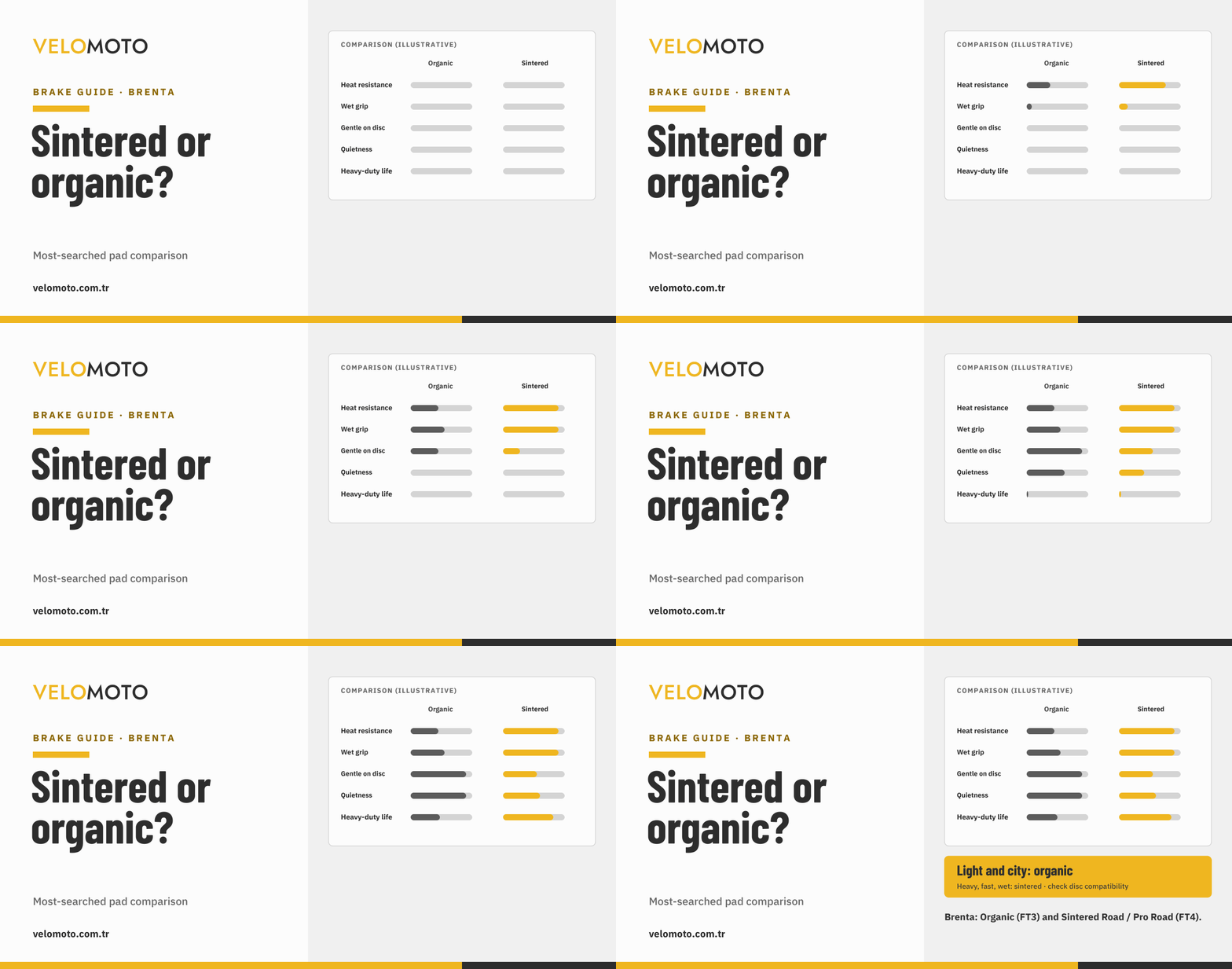
Choose organic pads for light motorcycles, scooters and city riding; choose sintered pads for heavy or fast motorcycles, riding with a passenger or load, hills and frequent rain. Organic pads are quiet, wear the disc lightly and give a soft brake feel, but they fade sooner at high temperatures and in the wet. Sintered pads resist heat and wet conditions and last longer under heavy use, but the disc must be suitable for sintered pads. At Brenta, organic codes start with FT3 and sintered codes with FT4.
Velomoto is the official distributor of Brenta products in Turkey.
What is an organic brake pad?
It is made by pressing fibers, fillers and a resin binder together; it is also known as NAO (non-asbestos organic).
- Runs quietly and smoothly; the brake feel is progressive.
- Wears the disc lightly.
- Usually more economical.
- Fades sooner than sintered pads at high temperatures and in the wet.
What is a sintered brake pad?
It is made by fusing metal powders together under high pressure and temperature (sintering).
- Resists high temperatures.
- Grips more consistently on wet surfaces.
- Lasts longer under heavy and intensive use.
- The brake feel is sharper; it can be a little noisier.
- The disc must be suitable for sintered pads.
Side-by-side comparison
| Property | Organic | Sintered |
|---|---|---|
| Heat resistance | Medium | High |
| Wet grip | Good | More consistent |
| Disc wear | Low | Normal on a suitable disc |
| Noise | Quiet | Can be a little noisier |
| Brake feel | Soft, progressive | Sharp, strong |
| Service life | Long under light use | Longer under heavy use |
| Suitable vehicles | Scooters, small to mid-size motorcycles | Maxi scooters, large motorcycles, off-road |
Hard or soft brake pads?
"Hard pad" usually describes the sharp feel of sintered pads, and "soft pad" the progressive feel of organic pads. Choose by how you ride, not by feel.
Which one for your motorcycle?
| Vehicle and use | Brenta series |
|---|---|
| 50–250 cc, city riding | Organic (Series 3, FT3) |
| Maxi scooter, large road motorcycle | Sintered Road (FT4) |
| Sport road riding | Pro Road |
| Passenger/load, hills, rain, courier work | Sintered Road |
| Off-road | Pro Off-Road |
| Track only | Ceramic Racing |
For the code structure, see our guide What is the difference between Brenta FT3 and FT4?

Products in this guide
Brenta brake pads
Organic, sintered and track brake pads made in Italy, ECE R90 approved. The 2026 catalog has application tables for more than 170 brands and 8,500+ models.
We do not sell directly to end users; you can find the products at our authorised dealers. See our dealers
Frequently asked questions
What is an organic brake pad?
A quiet, disc-friendly pad made from fibers, fillers and a resin binder.
What is a sintered brake pad?
A pad made by fusing metal powders, resistant to heat and wet conditions.
Should I choose hard or soft brake pads?
It depends on use: organic for light vehicles, sintered for heavy and fast motorcycles.
Which grips better in the rain?
Sintered pads are more consistent in the wet.
Do sintered pads wear the disc?
They wear a suitable disc normally; disc compatibility is a must.
Can I switch from organic to sintered?
Yes, if the disc is suitable; FT3 and FT4 codes with the same number are the same size.