Short answer
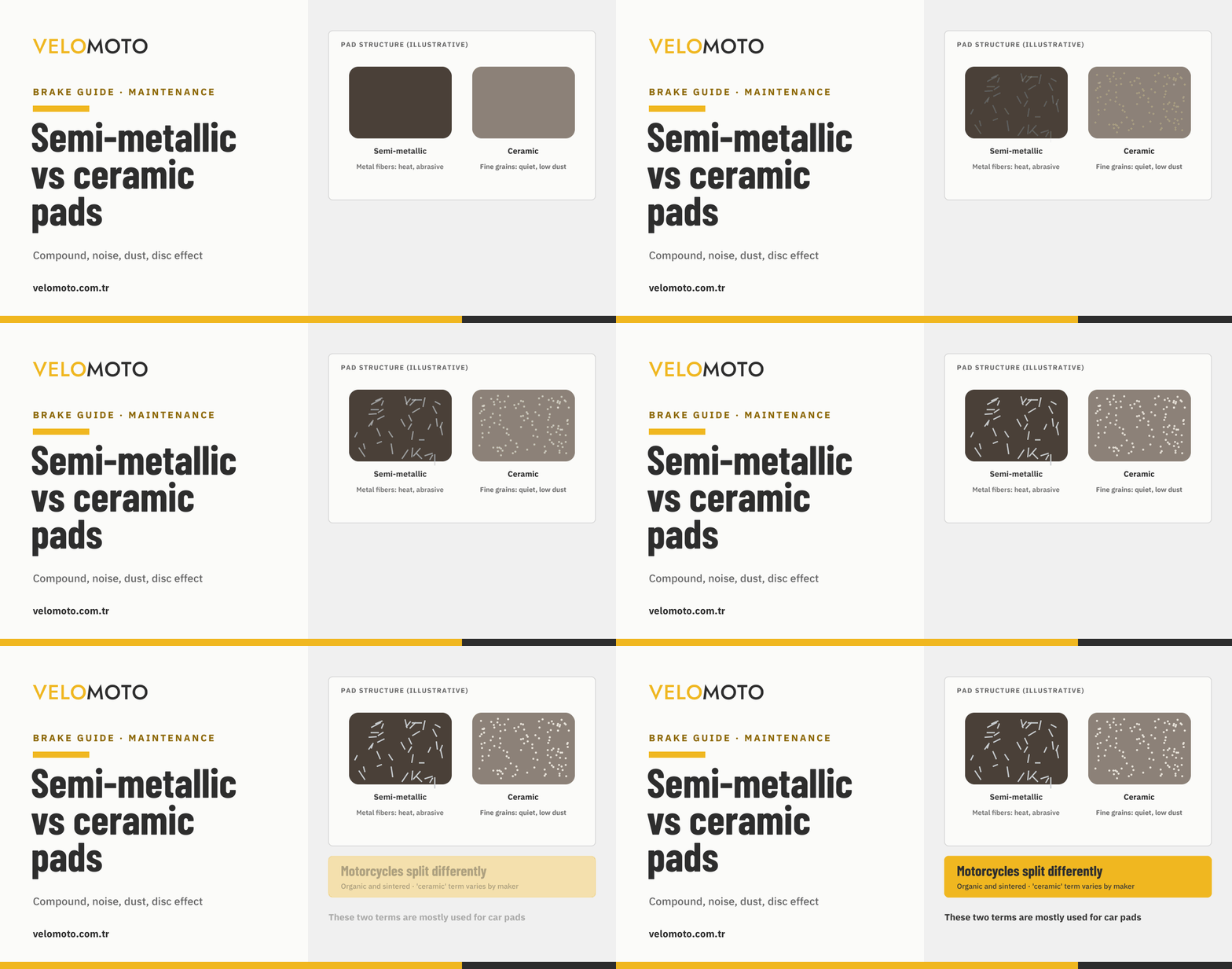
Semi-metallic pads resist heat and grip strongly, but they are noisier, produce more dust and wear the disc more; ceramic pads are quiet, low-dust and gentle on the disc, but more expensive. These two terms are used mostly for car brake pads. On motorcycles the main distinction is organic versus sintered; the name ceramic is used on motorcycles for different compounds depending on the manufacturer. For example, Brenta Ceramic Racing is a racing pad developed for track use only.
Velomoto is the official distributor of Brenta products in Turkey.
Semi-metallic vs ceramic comparison
| Property | Semi-metallic | Ceramic |
|---|---|---|
| Composition | About 30–70% metal (steel, iron, copper), graphite and fillers | Ceramic-based compound |
| Heat | Conducts heat well, withstands high temperatures | Withstands high temperatures, recovers quickly |
| Noise | Noisier | Quieter |
| Dust | Coarser and more | Finer and less |
| Disc wear | Higher | Lower |
| Price | Medium | Usually more expensive |
The comparison is based on general assessments made for car brake pads.
What these terms mean on motorcycles
| Term | On motorcycles |
|---|---|
| Organic | Common: scooters and small to mid-size motorcycles |
| Semi-metallic / semi-sintered | Intermediate compounds from some manufacturers; no standard definition |
| Sintered | Common: large motorcycles, maxi scooters, off-road |
| Ceramic | Varies by manufacturer; at Brenta, Ceramic Racing for track use only |
For Brenta's approach, see our guide Does Brenta make a semi-sintered pad?
What should I choose for my motorcycle?
- Look at the intended use, not the word on the label.
- For a motorcycle pad labeled ceramic, check on the box whether it is for road or track and whether it has ECE R90 approval.
- Make sure the disc is suitable for the pad compound.
For a detailed selection, see our guide Sintered or organic?

Products in this guide
Brenta brake pads
Organic, sintered and track brake pads made in Italy, ECE R90 approved. The 2026 catalog has application tables for more than 170 brands and 8,500+ models.
We do not sell directly to end users; you can find the products at our authorised dealers. See our dealers
Frequently asked questions
Are ceramic or semi-metallic pads better?
It depends on use: ceramic for quietness, semi-metallic for high heat.
Are there ceramic brake pads for motorcycles?
Some manufacturers use this name; the composition varies by brand. Brenta Ceramic Racing is for track use only.
Do semi-metallic pads wear the disc?
They wear it more than ceramic pads.
Are semi-metallic and sintered the same thing?
No. Sintered pads are made by fusing metal powders.
Why are ceramic pads expensive?
Their materials and production cost more.
Does car ceramic pad information apply to motorcycles?
Do not apply it directly; on motorcycles, look at the organic versus sintered distinction.