Short answer
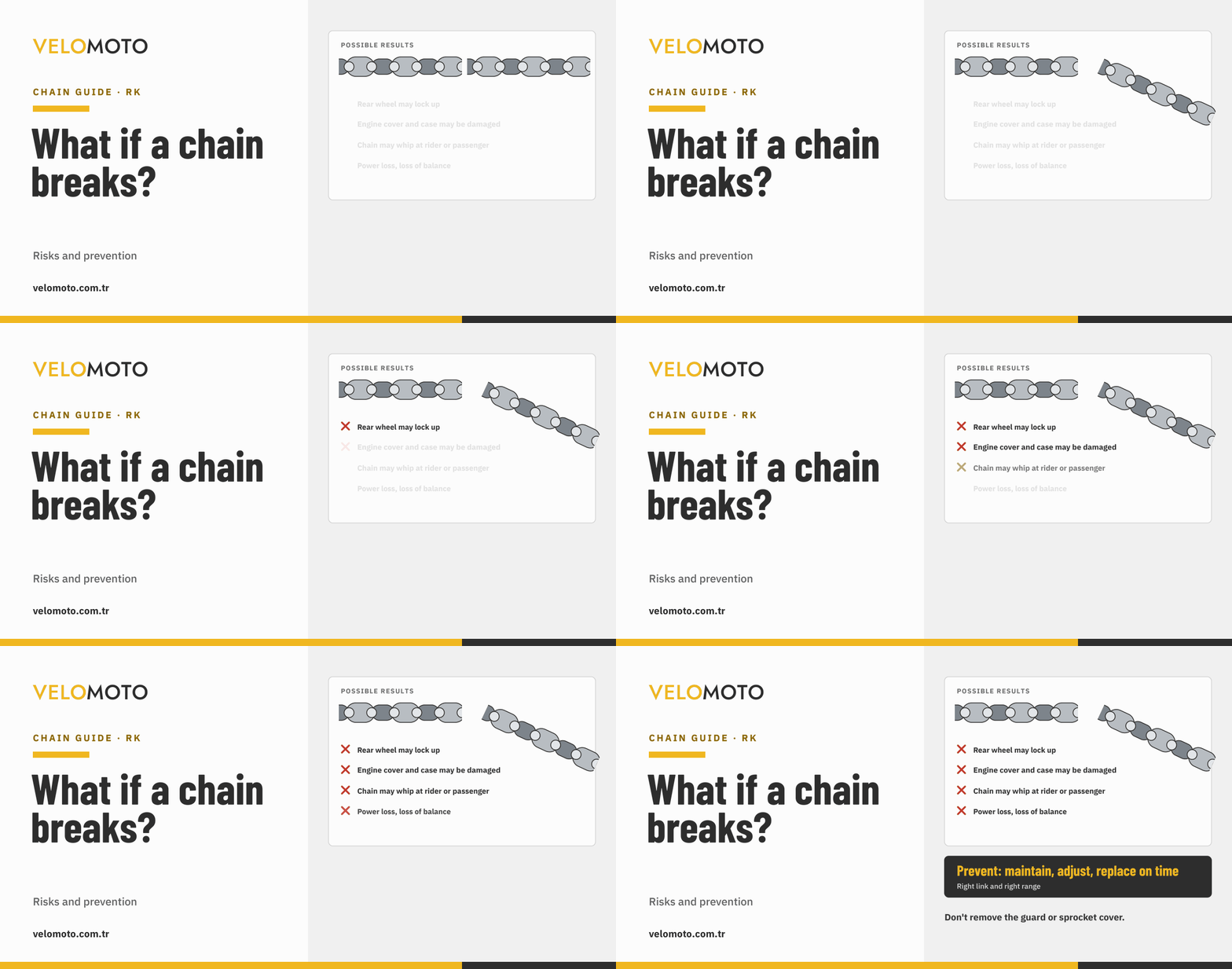
A chain that breaks while riding instantly cuts power to the rear wheel; if the chain wraps around the rear sprocket or the swingarm, the rear wheel can lock and the motorcycle can skid. A whipping chain can also damage the engine cover and crankcase around the front sprocket, the swingarm, cables, or the rider's legs.
Chains usually give warning before they break: stretching, frequent loosening, stiff links and pointed sprocket teeth. Regular maintenance, correct tension and timely kit replacement greatly reduce the risk of breakage.
Velomoto is the official distributor of RK Japan in Turkey.
What can happen when the chain breaks?
| Possible consequence | Why it happens |
|---|---|
| Sudden loss of power, engine revving up | Power transfer to the rear wheel is cut |
| Rear wheel lock-up and skidding | The chain wraps around the rear sprocket, swingarm or axle |
| Engine cover and crankcase damage | The chain jams around the front sprocket or strikes the cover |
| Swingarm, cable and sensor damage | The whipping chain hits surrounding parts |
| Rider or passenger injury | On a motorcycle without a guard, the chain can whip toward the legs |
The extent of the damage depends on speed, where the chain broke and the condition of the guard. In some cases the chain simply falls off; in others the crankcase cracks and an expensive repair is needed.
What to do if the chain breaks
- Pull the clutch in immediately to keep the engine from over-revving.
- If the rear wheel locks, try to keep the motorcycle upright and avoid sudden steering inputs.
- Slow down in a controlled way with the front brake and pull over to the side of the road in a safe place.
- Stop the engine; inspect the broken chain, the front sprocket cover and the crankcase.
- If there is a crack, oil leak or dent in the crankcase, do not start the engine; have the motorcycle transported.
Why do chains break?
- Stretched and worn chain: A stretched chain does not seat on the teeth, takes shocks and weakens.
- Worn sprockets: Shark-fin teeth put extra load on the chain.
- Incorrect master link installation: An improperly riveted link or a clip installed backwards can come open.
- Chain too loose: The chain jumps off the sprocket, jams and breaks.
- Chain too tight: Excessive load is placed on the chain, bearings and crankcase.
- Rust and stiff links: The links cannot flex, and cracks form in the plates.
- Heat cracking: According to RK, a chain repeatedly rubbing against a foreign object (a worn slider, a bolt) can cause heat cracks in the plates.
- Series not suited to the engine: A chain series that cannot handle the power fatigues early.
To prevent breakage
- Clean and lubricate the chain regularly and adjust its tension according to the owner's manual.
- Check for stretch, stiff links and sprocket wear at every service.
- Replace the chain, front and rear sprockets as a kit.
- Install the master link correctly; on high-powered motorcycles, choose a rivet-type link.
- Choose the RK series that matches your motorcycle's power.
- Do not remove the chain guard or the front sprocket cover.

Products in this guide
RK chains and sprockets
Chains and heat-treated sprockets made in Japan since 1953; original equipment supplier to many manufacturers including Honda, Yamaha, Suzuki and Kawasaki. 1,119 products and 3,786 model applications in the catalog.
We do not sell directly to end users; you can find the products at our authorised dealers. See our dealers
Frequently asked questions
Will the engine be damaged if the chain breaks?
Not always. But if the chain jams around the front sprocket or strikes the cover, the engine cover and crankcase can be damaged.
Does the rear wheel lock if the chain breaks?
It can. If the chain wraps around the rear sprocket or the swingarm, the rear wheel locks and the motorcycle can skid.
How do I know the chain has broken?
Power cuts out suddenly and the engine revs up; most of the time you hear a loud banging noise.
Does a chain give warning signs before it breaks?
Usually yes: frequent loosening, rattling, stiff links, rust and pointed sprocket teeth.
Can a broken chain be repaired and reused?
It is not recommended. A broken chain is already fatigued; the chain and sprockets should be replaced as a kit.
Can a clip-type master link cause breakage?
If it is not installed correctly, it can come open. The closed end of the clip should face the direction of chain travel; on high-powered motorcycles, a rivet-type link is preferred.