Short answer
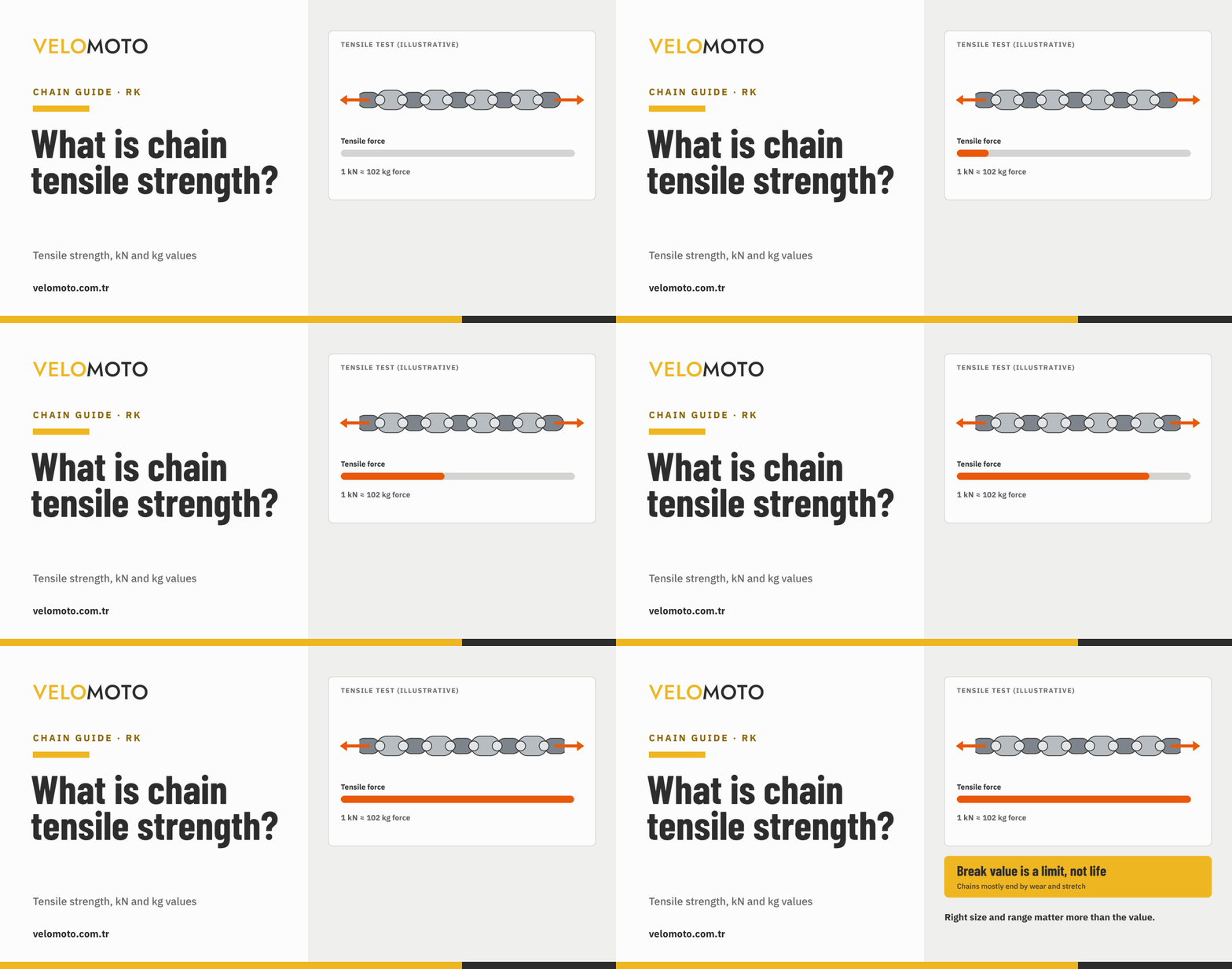
Tensile strength is the force at which a chain breaks when pulled from both ends; it is usually given in kilonewtons (kN), pounds (lbs) or kilograms of force (kgf). 1 kN equals about 102 kg of force. For example, according to data from a European spare parts retailer, the RK 520XSO chain has a tensile strength of 37 kN (about 3,770 kg of force), and the RK 520H heavy duty chain 34.3 kN (about 3,500 kg of force).
This value shows how much load the chain withstands in a single pull; it does not show how long the chain will last. Chains usually wear and stretch before they break.
Velomoto is the official distributor of RK Japan in Turkey.
How is tensile strength measured?
A section of chain is pulled from both ends in a testing machine, and the force is increased until the chain breaks. The force at the moment it breaks is the chain's tensile strength. Manufacturers usually give this value as an average or a minimum.
Unit conversion
| Unit | Equivalent |
|---|---|
| 1 kN (kilonewton) | About 102 kg of force (kgf) |
| 1 kgf | About 9.81 N |
| 1 lbf (pound-force) | About 4.45 N |
| 10 kN | About 1,020 kgf or 2,248 lbf |
Example values
| Chain | Type | Tensile strength | Approx. kg of force |
|---|---|---|---|
| RK 520H | 520, heavy duty, non-sealed | 34.3 kN | 3,500 kgf |
| RK 520XSO | 520, O-ring | 37 kN (8,318 lbs) | 3,770 kgf |
The values are taken from the product pages of a European spare parts retailer; for other series and sizes, see RK's technical data.
What does tensile strength not show?
- Service life: How many km a chain lasts is determined by wear and stretch, which are affected by the seal, lubrication, maintenance and use.
- Working load: A chain is never run continuously at loads close to its breaking value; repeated loads cause fatigue.
- Strength of a worn chain: A chain that is stretched, rusted or has run dry is weaker than a new one.
Material and production quality also affect a chain's fatigue strength. RK marks its plates with a laser instead of stamping; according to RK, stamp marks cut about 30 microns deep and thin the plate, reducing fatigue strength, while laser marking cuts no depth.
Should you choose a chain by tensile strength?
- First determine your motorcycle's size and link count.
- Choose a series suited to engine power and use; manufacturers recommend series by engine displacement and power.
- Among options in the same size, use tensile strength as a point of comparison.
- For long life, pay attention to seal type and maintenance.
For the difference between heavy duty and O-ring chains in the same size, see our guide What is a heavy duty (HD) chain?
Products in this guide
RK chains and sprockets
Chains and heat-treated sprockets made in Japan since 1953; original equipment supplier to many manufacturers including Honda, Yamaha, Suzuki and Kawasaki. 1,119 products and 3,786 model applications in the catalog.
We do not sell directly to end users; you can find the products at our authorised dealers. See our dealers
Frequently asked questions
What does tensile strength mean?
Breaking strength; the force at which a chain breaks when pulled from both ends.
How many kg is 1 kN?
About 102 kg of force. For example, 37 kN is about 3,770 kg of force.
Does a chain with higher tensile strength last longer?
Not always. Service life is determined by wear and stretch; seal type and maintenance matter more.
What is the tensile strength of an RK chain?
It varies by series and size; for example, 37 kN is given for the RK 520XSO and 34.3 kN for the RK 520H.
Why does a chain break?
Most often because it is badly stretched, dry or rusted, because of an incorrectly fitted master link, or because of sharp load shocks.
Does a master link reduce chain strength?
A correctly fitted rivet link works in the same class as the chain; on high-power motorcycles, a rivet link is recommended over a clip link.