Short answer
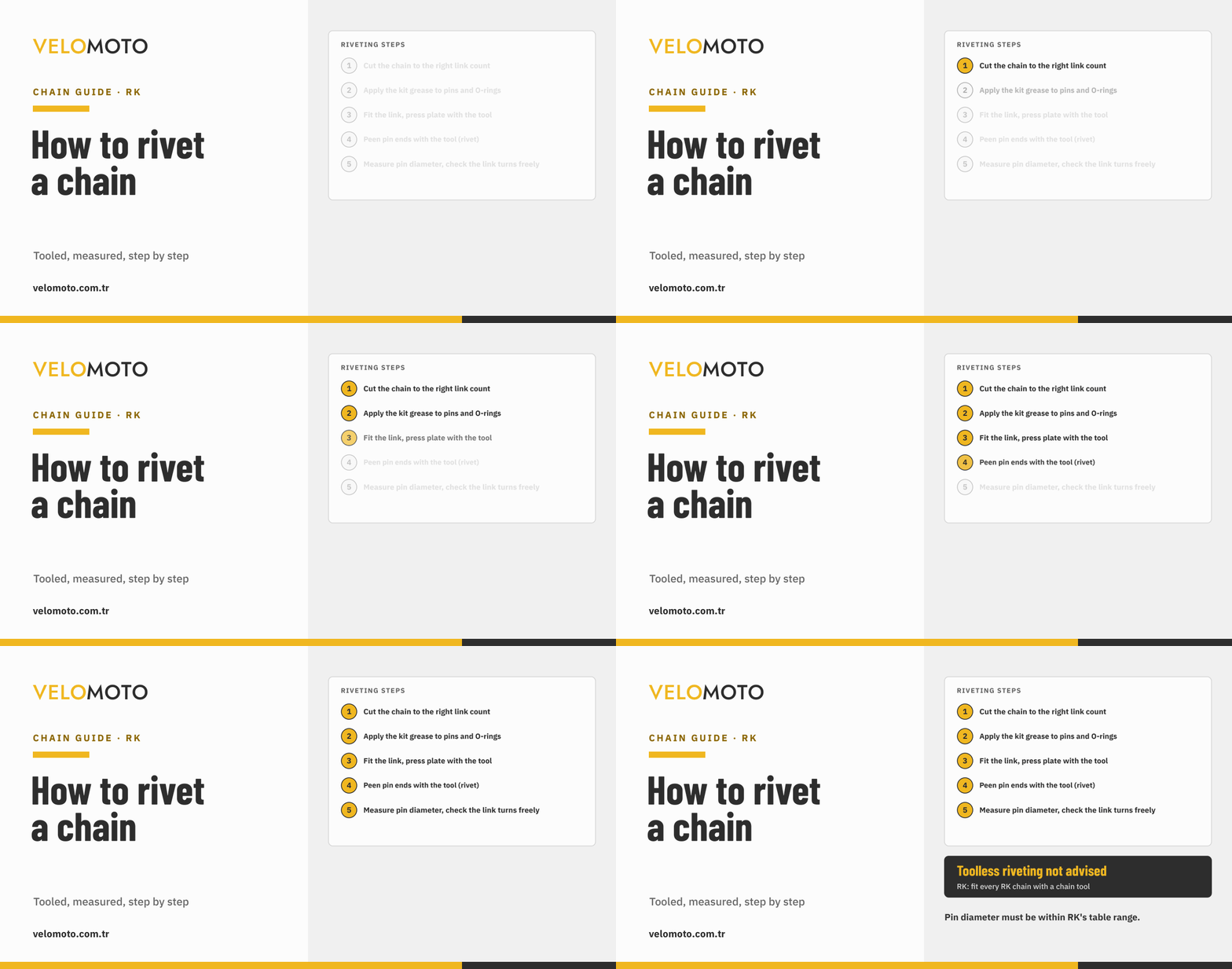
Riveting a chain means spreading the pin ends of a rivet-type master link with a chain tool so that the outer plate is fixed permanently. In short, the steps are: cut the chain to the correct link count, apply the grease supplied with the kit to the link's pins and O-rings, fit the link and press the outer plate on with the tool, spread the pin ends with the tool, then measure the rivet diameter and check that the link pivots freely.
RK recommends installing every RK chain with a chain tool. The pin ends should be spread enough to hold the plate, but the link must not bind; the rivet diameter must be between the minimum and maximum values in RK's table.
Velomoto is the official distributor of RK Japan in Turkey.
What you need
- Chain tool (a single tool or set that can cut, press and rivet)
- Rivet-type master link (same size and series as the chain; with its O-rings for an O-ring chain)
- The grease supplied with the master link kit
- Caliper gauge (to measure the rivet diameter)
- The motorcycle's owner's manual (for link count and chain slack)
RK's UCT2100(50) chain tool handles cutting the chain, shortening it to length, and installing clip-type or rivet-type master links. According to RK, the new generation of the tool has a redesigned rivet tip that prevents over-spreading the rivet.
Step-by-step riveting
- Confirm the link count: Compare the new chain with the old chain or with the value in the owner's manual. According to RK, links cannot be added if the chain is cut too short; count twice.
- Cut the chain: Remove the excess links by pushing out the pin with the chain tool.
- Apply grease: Apply the grease supplied with the master link kit to the link's pins and O-rings. Place the O-rings on the pins according to the kit's instructions.
- Fit the master link: Pass the master link through both ends of the chain from the inside (the motorcycle side).
- Press on the outer plate: Using the tool, press the outer plate on until it is the same width as the other links. Pressing too far crushes the O-rings and makes the link bind.
- Rivet: Spread the end of each pin separately with the tool's rivet tip.
- Measure and check: Measure the rivet diameter with the caliper and compare it with the range in RK's table. Flex the link by hand; it should pivot freely like the other links. There should be no cracks at the ends.
- Adjust: Adjust chain slack and axle alignment according to the owner's manual.
Common mistakes
- Under-riveting: The plate loosens over time and can come off.
- Over-riveting: The pin end cracks or the link binds, creating a stiff link.
- Pressing the outer plate too far: The O-rings are crushed and lose their sealing function.
- Forgetting the O-rings: The master link is left without grease and wears quickly.
- Riveting without the proper tool: A rivet made with a hammer and punch does not spread evenly and damages the plate. According to RK, tools not designed for the chain can damage it, create a safety risk and may void the warranty.

Products in this guide
RK chains and sprockets
Chains and heat-treated sprockets made in Japan since 1953; original equipment supplier to many manufacturers including Honda, Yamaha, Suzuki and Kawasaki. 1,119 products and 3,786 model applications in the catalog.
We do not sell directly to end users; you can find the products at our authorised dealers. See our dealers
Frequently asked questions
Is a chain riveting tool required?
Yes. RK recommends installing every RK chain with a chain tool; a rivet made without the tool does not spread properly.
Can you rivet without a tool?
It is not recommended. A rivet made with a hammer weakens the link and may affect the warranty; if you do not have the tool, have the job done at an authorized service center.
Should the master link's pins and bushings be greased?
Yes. The grease supplied with the kit is applied to the pins and O-rings before installation. The rest of the chain is greased at the factory.
What should the rivet diameter be?
It depends on the chain series; check the minimum and maximum values in RK's rivet diameter table.
Can a rivet-type link be removed later?
It can be removed but not reused; a new link is needed to reinstall.
What if the link pivots stiffly after riveting?
The outer plate may have been pressed on too far or the rivet spread too much; replace the master link.